 Skip to content
When you search for water damage mitigation near me, speed of response is the single biggest factor in how much of your Atlanta property can be saved. This guide explains the difference between water mitigation and full restoration, what happens during emergency extraction and structural drying, how Atlanta’s humid subtropical climate affects the mitigation timeline, and how to protect your insurance claim throughout. Air Drop Water Restoration, IICRC-certified and serving metro Atlanta since 2012, operates a 24/7 emergency-first mitigation model across Fulton, DeKalb, Cobb, Gwinnett, and Clayton counties.
Table of Contents
Water Damage Mitigation Near Me: Atlanta’s 24/7 Emergency Response Guide
When you search water damage mitigation near me, you’re racing against a clock that most people don’t realize is already ticking. Whether it’s a burst pipe in a Buckhead condo, storm flooding in a Gwinnett County basement, or a slow leak finally discovered in a Cobb County kitchen, the speed of your mitigation response is the single biggest factor in how much of your property can ultimately be saved.
Metro Atlanta’s humid subtropical climate, combined with frequent summer thunderstorms and occasional winter freeze events, makes the region particularly susceptible to both storm-related flooding and burst-pipe emergencies. Untreated moisture can lead to measurable mold colonization within just 24 to 48 hours, and structural wood can begin to warp or delaminate within days of prolonged saturation. Air Drop Water Restoration, an IICRC-certified restoration company serving the Atlanta metro since 2012, operates on an emergency-first model precisely because of this narrow window.
This guide explains what water damage mitigation actually involves, how it’s different from full restoration, and what to expect from a professional response across Fulton, DeKalb, Cobb, Gwinnett, and Clayton counties.
What Is Water Damage Mitigation?
Quick Answer: Water damage mitigation is the emergency process of extracting standing water, removing damaged materials that can’t be salvaged, and structurally drying a property to stop further damage, distinct from restoration, which repairs and rebuilds the property afterward.
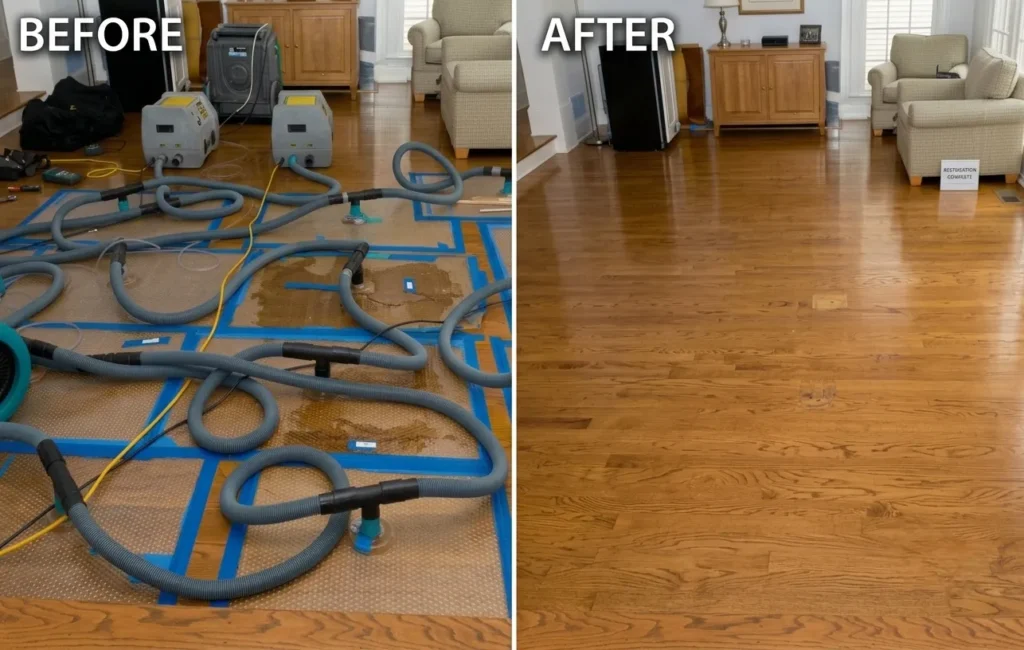
Mitigation is about stopping the bleeding: extracting water, protecting salvageable belongings, and drying the structure before secondary damage like mold and structural decay can take hold. It’s the first and most time-sensitive phase of recovering from any water event.
Water Categories and Classes Explained
Professional water damage mitigation follows the IICRC S500 standard, the industry benchmark that classifies water intrusion by contamination level and affected area.
| Water Category | Source | Example |
| Category 1 | Clean water | Supply line break, clean water heater failure |
| Category 2 | Gray water, some contamination | Washing machine overflow, dishwasher discharge |
| Category 3 | Black water, grossly contaminated | Sewage backup, flood water from outside |
| Class | Description |
| Class 1 | Small area affected, minimal moisture absorption |
| Class 2 | Entire room affected, water wicked up walls |
| Class 3 | Water from overhead, walls and ceilings saturated |
| Class 4 | Deep saturation into hardwood, concrete, or plaster requiring specialized drying |
Understanding category and class matters because both determine the mitigation approach, the equipment required, and whether materials can be dried in place or must be removed.
How is water categorized during mitigation?
Water is classified under IICRC S500 standards into three categories, Category 1 (clean), Category 2 (gray water with some contamination), and Category 3 (black water, grossly contaminated), each requiring different protective and remediation protocols.
The Water Damage Mitigation Process, Step by Step
| Step | What Happens |
| 1. Emergency Dispatch | Technician confirms address, safety concerns, and ETA by phone |
| 2. Safety & Source Control | Shut off water source and assess electrical hazards |
| 3. Water Category Assessment | Classify water per IICRC S500 standards |
| 4. Emergency Extraction | Truck-mounted or portable extraction equipment removes standing water |
| 5. Moisture Mapping | Thermal imaging and moisture meters locate hidden saturation behind walls and under flooring |
| 6. Structural Drying | Industrial air movers and dehumidifiers dry affected materials |
| 7. Monitoring | Daily moisture readings to confirm materials are drying on schedule |
| 8. Documentation | Photos, moisture logs, and scope-of-work reports for insurance purposes |
A small, contained Class 1 loss might be resolved in 2 to 3 days, while larger Class 3 or Class 4 losses involving saturated structural materials can take a week or more of continuous monitoring and drying.
Expert Insight: “People often think once the standing water is gone, the job is done. But hidden moisture behind walls or under flooring is what actually causes mold problems weeks later if it isn’t properly dried and monitored.” Air Drop Water Restoration mitigation team
Related Reading: Emergency Water Extraction Services | Mold Remediation Services | Water Damage Repair Near Me
Water actively spreading through your Atlanta property right now? Air Drop Water Restoration’s 24/7 mitigation teams deploy truck-mounted extraction and industrial drying equipment across metro Atlanta. Call now for immediate dispatch.
Why Response Time Matters So Much in Atlanta
Metro Atlanta’s humid subtropical climate keeps ambient humidity elevated for much of the year, which creates two compounding problems for water mitigation:
- Faster category degradation: Clean, Category 1 water can begin absorbing contaminants and supporting microbial growth more quickly when ambient humidity is already high, shortening the safe mitigation window.
- Slower natural drying: Without professional dehumidification, wet materials in Atlanta’s humid air take significantly longer to dry naturally than they would in a drier climate, increasing the risk of secondary mold damage the longer mitigation is delayed.
This is why Air Drop Water Restoration treats every water mitigation call across metro Atlanta as time-sensitive, deploying equipment calibrated to local humidity and temperature conditions rather than one-size-fits-all protocols.
Related Reading: Plumbing Service | Water Damage Service | Commercial Restoration Services
Don’t wait for standing water to become a mold problem. Schedule a moisture assessment with Air Drop Water Restoration today, especially if a leak has gone unaddressed for more than 24 hours.
Water Mitigation vs. Water Damage Restoration
| Water Mitigation | Water Damage Restoration | |
| Goal | Stop further damage; extract and dry | Repair and rebuild to pre-loss condition |
| Timeline | Hours to about a week | Days to weeks, depending on scope |
| Typical Work | Extraction, drying, moisture monitoring | Drywall, flooring, painting, reconstruction |
| Urgency | Immediate, time-sensitive | Scheduled following mitigation |
Using one company for both phases, like Air Drop Water Restoration, often results in fewer miscommunications, faster turnaround, and more consistent documentation for insurance purposes, compared to coordinating between separate mitigation and repair contractors.
Residential vs. Commercial Water Mitigation
Homeowners in neighborhoods like Grant Park, Buckhead, and Virginia-Highland face different mitigation needs than commercial properties in Midtown, Downtown, or industrial corridors near Hartsfield-Jackson Atlanta International Airport in Clayton County.
Commercial water mitigation often involves:
- Coordinating around business hours or 24/7 operations
- Protecting sensitive equipment, inventory, and server rooms
- Larger-scale drying operations across warehouses or multi-unit buildings
- More complex insurance and property management communication chains
Air Drop Water Restoration structures its mitigation response to scale appropriately, whether the job is a single flooded bathroom in Smyrna or a multi-floor commercial flood in downtown Atlanta.
Managing a commercial property with water damage? Air Drop Water Restoration’s commercial mitigation teams scale to fit warehouses, offices, and multi-unit buildings across metro Atlanta.
Insurance and Water Damage Mitigation
In most cases, sudden and accidental water damage, such as a burst pipe, is covered under standard Georgia homeowners insurance policies, though flood damage typically requires separate flood insurance coverage through a program like the National Flood Insurance Program.
To support your mitigation-related claim:
- Document the water source and discovery time
- Keep all mitigation invoices and equipment logs
- Request detailed moisture logs and photo documentation throughout the drying process
- Retain the scope-of-work report connecting mitigation to any later repair work
Air Drop Water Restoration provides detailed photo documentation, moisture logs, and scope-of-work reports designed to support your insurance claim from day one, working directly with your adjuster so you’re not left translating industry jargon on your own.
Preventing Water Damage Emergencies
- Schedule regular plumbing inspections, particularly for homes with galvanized or original-to-construction pipes
- Ensure gutters and downspouts direct water well away from the foundation
- Install a battery-backup sump pump for basements in flood-prone areas
- Monitor water heater age; most units have a functional lifespan of 8 to 12 years
- Know the location of your main water shutoff valve before an emergency occurs
- Grade landscaping to direct storm runoff away from your foundation, particularly important given Atlanta’s clay-heavy soil and hilly terrain.
Frequently Asked Questions About Water Damage Mitigation Near Me Atlanta Ga
How fast does water damage mitigation near me need to start?
Ideally within hours of discovering the water intrusion. Mold colonization can begin within 24 to 48 hours, so rapid extraction and drying significantly reduce total damage.
What’s the difference between water damage mitigation and water damage restoration?
Mitigation stops further damage through extraction and drying; restoration repairs and rebuilds the property afterward. Many companies, including Air Drop Water Restoration, handle both phases.
How much does water damage mitigation cost in Atlanta?
Costs vary based on water category, class, and affected square footage. A professional on-site assessment provides the most accurate estimate, and many companies offer this free of charge.
Will my insurance cover water damage mitigation?
Standard homeowners policies generally cover sudden, accidental water damage like a burst pipe, but typically exclude flood damage unless a separate flood insurance policy is in place.
How long does structural drying take after water damage mitigation?
A small, contained Class 1 loss might dry in 2 to 3 days, while larger Class 3 or Class 4 losses involving saturated structural materials can take a week or more of continuous monitoring.
Can I stay in my home during water damage mitigation?
In many cases, yes, particularly for localized damage. However, extensive Category 2 or Category 3 water damage may warrant temporary relocation for safety reasons until affected areas are properly sanitized.
Are all my belongings ruined after water damage?
Not always. Many items can be cleaned, dried, and restored, particularly if addressed quickly. Porous materials exposed to contaminated Category 3 water, however, often cannot be safely salvaged.
What areas does Air Drop Water Restoration cover for water damage mitigation near me?
Air Drop Water Restoration provides emergency water damage mitigation across the greater Atlanta metro, including Fulton, DeKalb, Cobb, Gwinnett, and Clayton counties, and cities such as Marietta, Decatur, Alpharetta, Sandy Springs, Roswell, Duluth, and Smyrna.
onclusion: Water Damage Mitigation Near Me In Atlanta
When water intrudes into your Atlanta home or business, the speed and quality of your water damage mitigation response determines how much of your property, and your peace of mind, can be preserved. From emergency extraction to structural drying and insurance documentation, Air Drop Water Restoration has served metro Atlanta since 2012 with an IICRC-certified, emergency-first approach across Fulton, DeKalb, Cobb, Gwinnett, and Clayton counties.
Water damage emergency at your Atlanta property? Don’t wait. Call Air Drop Water Restoration’s 24/7 line now for immediate mitigation dispatch.