 Skip to content
Emergency water damage restoration in Atlanta requires fast extraction, structural drying, and mold prevention. This complete guide explains the full process, timelines, and insurance considerations.
Table of Contents
Emergency water damage restoration is the process of stopping active water intrusion, extracting standing water, drying the structure, and repairing a property back to its pre-loss condition, and in metro Atlanta, few decisions matter more than how quickly and correctly that process begins. Whether the source is a burst pipe in Marietta, a flash flood following a summer storm in Sandy Springs, or a failed water heater in a Decatur bungalow, the first 24 to 48 hours determine whether you are dealing with a straightforward mitigation project or a much larger mold and structural repair problem.
This guide walks through the entire emergency water damage restoration process, from the moment water starts flowing to the final repair, so you know exactly what to expect and what questions to ask before hiring a restoration company in Atlanta.
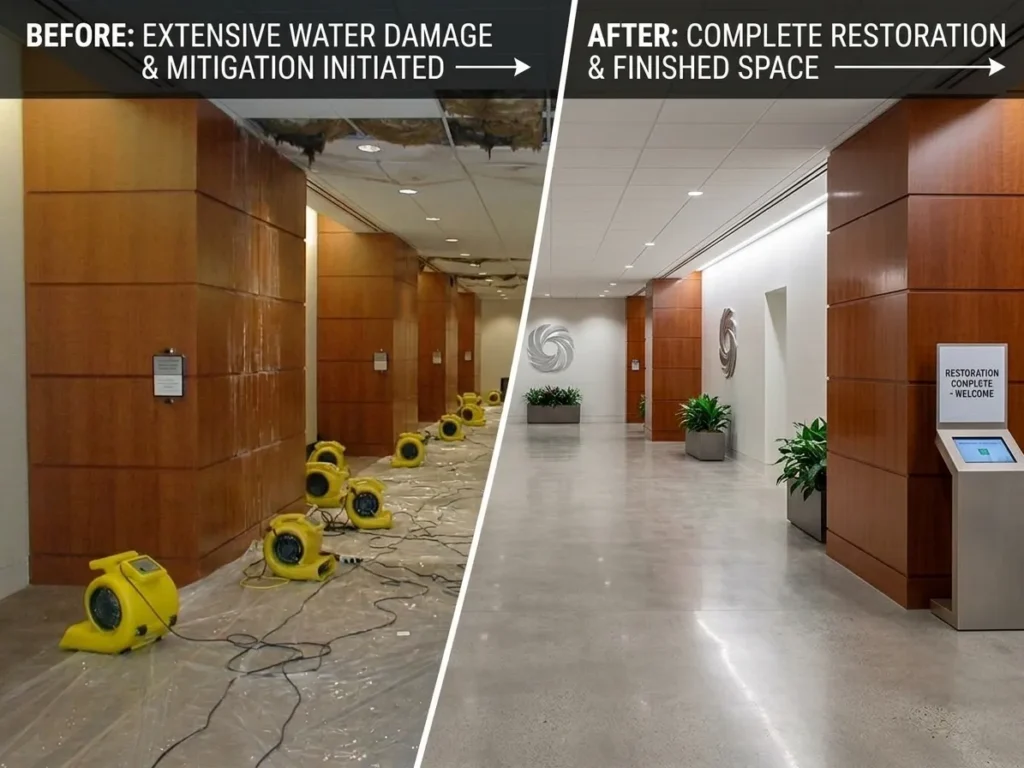
What Is Emergency Water Damage Restoration
Emergency water damage restoration is the complete process of responding to active water intrusion, extracting standing water, drying affected structural materials, and repairing or rebuilding damaged areas to return a property to its condition before the loss occurred. It differs from water mitigation, which refers specifically to the initial emergency response phase, extraction, containment, and drying, while restoration includes the full repair process afterward.
The IICRC Water Damage Category and Class System
Professional restoration companies classify water damage using the IICRC S500 standard, the industry benchmark for water damage restoration:
| Category | Water Type | Description |
| Category 1 | Clean water | From a clean source, such as a supply line, with no contamination |
| Category 2 | Gray water | Contains contamination, such as from a washing machine or dishwasher discharge |
| Category 3 | Black water | Grossly contaminated, such as sewage backups or floodwater |
| Class | Description |
| Class 1 | Minimal water absorption, limited to a small area |
| Class 2 | Significant absorption into materials, affecting an entire room |
| Class 3 | Greatest amount of moisture absorption, water may have come from overhead |
| Class 4 | Specialty drying situations involving low-porosity materials like hardwood or concrete |
Read our Water Damage Restoration Services
The Full Restoration Timeline, Hour by Hour
- Hour 0–1: Emergency call placed, technicians dispatched, targeting arrival within approximately one hour across core Atlanta metro service areas.
- Hour 1–3: Site assessment, safety check for electrical hazards, water category and class classification, containment established.
- Hour 3–24: Standing water extraction using truck-mounted or portable extraction equipment, moisture mapping using penetrating and non-invasive meters and thermal imaging.
- Day 1–5: Structural drying using industrial air movers and commercial dehumidifiers calibrated to Atlanta’s humidity levels, with daily moisture monitoring.
- Day 3–7: Removal of unsalvageable materials, such as saturated drywall, carpet padding, or insulation
- Week 1–4+: Reconstruction and repair, rebuilding drywall, flooring, and cabinetry, with timeline depending on scope, permitting, and material availability.
Water damage doesn’t wait, and neither should you. Call Air Drop Water Restoration now for emergency dispatch across metro Atlanta.
Common Causes of Water Damage in Metro Atlanta
- Burst or leaking pipes, particularly in homes with aging galvanized plumbing throughout Decatur, East Atlanta, and Stone Mountain.
- Water heater failures, common in homes eight to twelve years old.
- Sump pump failures during heavy summer storms across low-lying areas of Cobb and Gwinnett counties.
- Roof leaks following severe thunderstorms.
- HVAC condensate line clogs.
- Sewage backups linked to aging municipal infrastructure and tree root intrusion.
Why Atlanta’s Climate Accelerates Water Damage
Atlanta’s humid subtropical climate, combined with frequent summer thunderstorms and occasional winter freeze events, makes the metro area particularly susceptible to both storm-related flooding and burst-pipe events. Without professional dehumidification, wet materials in Atlanta’s humid air take significantly longer to dry naturally than they would in a drier climate, increasing the risk of secondary mold damage the longer mitigation is delayed. This is why professional restoration companies calibrate drying equipment specifically to local humidity and temperature conditions rather than applying one-size-fits-all protocols.
Water Mitigation vs. Water Damage Restoration: Key Differences
| Water Mitigation | Water Damage Restoration |
| Emergency response phase | Full recovery process |
| Extraction, containment, drying | Includes mitigation plus repair and rebuild |
| Focused on stopping further damage | Focused on returning property to pre-loss condition |
| Typically hours to days | Can extend to weeks depending on scope |
What Equipment Professional Restoration Companies Use
- Truck-mounted and portable extraction units for rapid removal of standing water
- Penetrating and non-invasive moisture meters to measure moisture content in materials
- Thermal imaging cameras to identify hidden moisture beyond what is visible
- Industrial air movers to accelerate surface drying
- Commercial dehumidifiers calibrated for high-humidity environments like metro Atlanta
- HEPA air scrubbers to manage air quality during drying and any related mold concerns
Read our Emergency Water Extraction Services
Working With Your Insurance Adjuster
- Document damage with photos and video immediately, before any extraction begins if it is safe to do so
- Request a detailed moisture log and category/class classification from your restoration company
- Keep all receipts related to emergency mitigation, temporary repairs, and additional living expenses
- Choose a restoration company experienced in direct adjuster communication, which significantly reduces claim disputes and delays
Confused about your water damage insurance claim? Air Drop Water Restoration works directly with your adjuster from day one.
Frequently Asked Questions About Emergency Water Damage Restoration in Atlanta Ga
What is the difference between water mitigation and emergency water damage restoration?
Water mitigation is the emergency response phase, extraction, containment, and drying, focused on stopping further damage. Emergency water damage restoration includes mitigation plus the full repair process to return the property to pre-loss condition.
How fast should emergency water damage restoration begin after water intrusion?
Ideally within one to two hours. Mold can begin colonizing damp materials within 24 to 48 hours, so rapid extraction and drying significantly reduce both damage and cost.
What are the IICRC water damage categories?
Category 1 is clean water from an uncontaminated source, Category 2 is gray water with some contamination, and Category 3 is grossly contaminated black water, such as sewage or floodwater, each requiring different protective protocols.
How long does emergency water damage restoration take in Atlanta?
Extraction and initial drying typically take three to seven days, while full restoration and repair can extend from one to several weeks depending on the extent of damage and material availability.
Will my homeowners insurance cover emergency water damage restoration?
Most policies cover sudden, accidental water damage, such as burst pipes, though coverage details vary. Proper documentation and prompt reporting significantly improve claim outcomes.
Can I do emergency water extraction myself with a wet/dry vacuum?
For very minor water intrusion, a wet/dry vacuum may help, but professional extraction and moisture mapping are necessary to identify hidden moisture in walls, subflooring, and insulation that household equipment cannot detect.
Why does Atlanta’s climate make water damage restoration more urgent?
Atlanta’s humid subtropical climate slows natural drying significantly, meaning wet materials remain saturated longer without professional dehumidification, increasing the risk of secondary mold damage the longer mitigation is delayed.
What areas does Air Drop Water Restoration cover for emergency water damage restoration?
Air Drop Water Restoration serves Atlanta, Sandy Springs, Marietta, Roswell, Alpharetta, Johns Creek, Dunwoody, Brookhaven, Decatur, Smyrna, Kennesaw, Lawrenceville, Duluth, and surrounding communities across Fulton, DeKalb, Cobb, Gwinnett, Clayton, Henry, Rockdale, Douglas, Cherokee, Fayette, and Coweta counties.
Conclusion on Emergency Water Damage Restoration in Atlanta Ga
Emergency water damage restoration is a race against time, moisture, and Atlanta’s humid climate, all of which work against you the longer a response is delayed. Understanding the full process, from the IICRC classification system to structural drying to insurance documentation, helps you make faster, more confident decisions when water damage strikes. Air Drop Water Restoration brings certified technicians, calibrated equipment, and direct insurance coordination to every emergency call across metro Atlanta.
Don’t let water damage spread. Call Air Drop Water Restoration now for 24/7 emergency water damage restoration across metro Atlanta.