 Skip to content
Searching for leakage repair near me in Atlanta? This guide walks Atlanta homeowners and business owners through how to identify a hidden or active water leak, what to do in the first 30 minutes, how professional leak detection and mitigation works under the IICRC S500 standard, and how to protect your insurance claim. Air Drop Water Restoration explains category-of-water classifications, common Atlanta leak sources (slab leaks, burst pipes, roof and ceiling leaks, appliance failures), the real cost of delaying repair, and what a 24/7 emergency response team actually does on-site, from moisture mapping to structural drying, so you know exactly what to expect before help arrives.
Table of Contents
If you’re typing “leakage repair near me Atlanta” into your phone right now, there’s a good chance water is actively spreading across your floor, seeping down a wall, or pooling somewhere it shouldn’t be, and every minute matters. As a restoration contractor who has walked into hundreds of Atlanta homes and businesses mid-crisis, I can tell you the single biggest factor separating a $1,200 repair from a $12,000 reconstruction project is response time, not the size of the leak itself.
Atlanta’s humid subtropical climate, aging plumbing infrastructure in neighborhoods like Decatur, Brookhaven, and East Atlanta, and a housing stock that spans century-old craftsman homes to new-build slab-on-grade construction in Alpharetta and Suwanee, all combine to make leaks one of the most common property emergencies in the metro area. Whether it’s a slab leak under a Sandy Springs kitchen, a burst supply line in a Marietta basement, or a slow ceiling leak in a Smyrna condo, the underlying physics is the same: water finds the path of least resistance, and it does not wait for business hours.
This guide breaks down exactly what “leakage repair” means at each stage, from the first signs of a leak through professional detection, water extraction, structural drying, and repair, so you know what to look for, what to do in the first 30 minutes, and what a licensed restoration company should be doing once they arrive at your Atlanta property.
Dealing with a leak right now? Don’t wait for it to get worse. Call Air Drop Water Restoration for 24/7 emergency leakage repair anywhere in metro Atlanta.
What Counts as “Leakage Repair” in the Restoration Industry
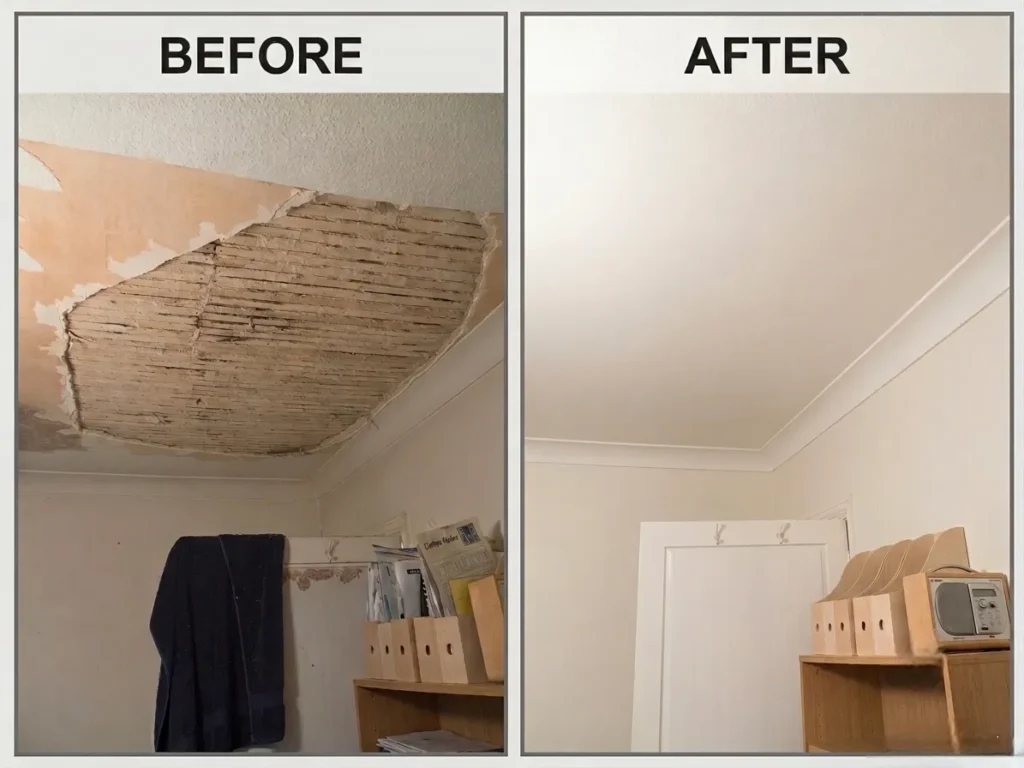
In restoration terminology, leakage repair covers two distinct but connected phases. The first is leak detection and mitigation, locating the source, stopping active water intrusion, and extracting standing water before it migrates into subfloors, wall cavities, and insulation. The second is structural repair, replacing or restoring the materials that were damaged, drywall, subfloor, baseboards, cabinetry, and in some cases framing lumber.
Homeowners often assume a plumber “fixing the leak” is the end of the job. In reality, stopping the water is only step one. Moisture that has already traveled into porous building materials, drywall, wood subfloor, carpet padding, insulation, continues causing damage long after the pipe is patched unless it is professionally extracted and dried using commercial dehumidification and air-moving equipment.
The IICRC S500 Water Category Classification
Every legitimate leakage repair and water damage restoration company in Atlanta should evaluate your leak against the IICRC S500 standard, the industry benchmark referenced by insurance adjusters nationwide. This classification determines the protective equipment, drying protocol, and in some cases whether materials can be dried in place or must be removed.
| Category | Source | Typical Examples | Restoration Approach |
| Category 1 | Clean water | Supply line breaks, water heater failure, rainwater intrusion | Dry in place where possible; low contamination risk |
| Category 2 | Gray water | Dishwasher/washing machine discharge, aquarium leaks, toilet overflow (no solids) | Requires disinfection; some materials removed |
| Category 3 | Black water | Sewage backups, flooding from rivers/storm surge, standing water beyond 72 hours | Full removal of porous materials; biohazard protocols |
A leak that starts as Category 1 clean water can degrade into Category 2 within 24-48 hours if left unaddressed, which is precisely why response speed matters as much as the repair itself.
Common Sources of Leaks We Repair Across Metro Atlanta
Leak calls across Fulton, DeKalb, Cobb, and Gwinnett counties tend to cluster around a handful of recurring culprits. Recognizing which type you’re dealing with helps you describe the problem accurately when you call for leakage repair near you.
- Slab leaks: common in Atlanta’s older concrete-slab foundations, often first noticed as unexplained high water bills or warm spots on flooring
- Burst or frozen pipes: particularly during Georgia’s occasional winter freeze events, when copper and older galvanized piping is vulnerable
- Roof and ceiling leaks: accelerated by Atlanta’s frequent summer thunderstorms and aging shingle roofs in neighborhoods like Decatur and Stone Mountain
- Water heater failures: tank corrosion or fitting failure, often discovered in basements and utility closets
- Appliance and supply line leaks: washing machine hoses, dishwasher lines, and refrigerator ice-maker lines are among the most common residential leak sources
- HVAC condensate line leaks: frequently missed until ceiling staining appears, especially in Georgia’s high-humidity summers
- Foundation and grading-related seepage: heavy rainfall pooling against foundations in homes without proper drainage
Signs You Need Leakage Repair in Atlanta Homes Right Now
Some leaks announce themselves immediately. Others hide for weeks. Below is a quick-reference checklist we use during initial phone triage with Atlanta homeowners.
- Visible water pooling on floors, or damp carpet with no obvious cause
- A musty odor, particularly in basements, crawlspaces, or behind cabinetry
- Discoloration, bubbling, or staining on ceilings and walls
- An unexplained spike in your water bill
- The sound of running water when all fixtures are off
- Warped, soft, or buckling flooring, especially hardwood or laminate
- Peeling paint or wallpaper near baseboards or window frames
- Warm or unusually damp spots on slab flooring (a hallmark of slab leaks)
If you notice standing water, active dripping, or a strong musty smell in your Atlanta home, shut off the water at the source if safely possible, move valuables away from the affected area, and call a certified leakage repair and water damage restoration company immediately. Waiting even 24-48 hours significantly increases the risk of mold colonization.
What to Do in the First 30 Minutes After Discovering a Leak
- Shut off the water supply at the source valve, or the main shutoff if the source is unclear
- Cut power to any outlets or fixtures near standing water if it is safe to do so
- Photograph the damage before moving anything, this documentation matters for your insurance claim
- Remove or elevate furniture, rugs, and electronics from the affected area
- Call a certified restoration company for emergency leak detection and water extraction
- Avoid running fans directly over standing water, which can spread contamination in Category 2 or 3 situations.
Our certified technicians follow IICRC-standard protocols from first contact to final walkthrough. Schedule your free moisture assessment with Air Drop Water Restoration today.
How Professional Leakage Repair Works: Our Atlanta Process
When Air Drop Water Restoration responds to a leakage repair call anywhere in metro Atlanta, from a Buckhead high-rise to a Peachtree City single-family home, the process follows a consistent, IICRC-informed sequence.
Emergency Dispatch and Assessment
A certified technician is dispatched, targeting rapid on-site arrival. On arrival, the crew performs a visual inspection and uses non-invasive and penetrating moisture meters, along with thermal imaging cameras, to map the true extent of moisture migration, which is frequently far larger than what’s visible on the surface.
Leak Source Identification
Before drying begins, the source must be confirmed and stopped. For slab leaks, this may involve coordination with a licensed plumber for electronic leak detection. For roof or ceiling leaks, technicians trace water paths back through attic spaces and framing to the actual point of entry, which is often several feet from where staining appears.
Water Extraction
Standing water is removed using truck-mounted or portable extraction equipment. Category 2 and 3 water requires additional containment and disinfection protocols to protect indoor air quality and prevent cross-contamination.
Structural Drying and Dehumidification
Commercial-grade air movers and dehumidifiers are positioned based on the moisture map, not guesswork. In Atlanta’s humid climate, natural air-drying is rarely sufficient; ambient humidity levels typically require mechanical dehumidification to bring building materials back to a safe moisture content before mold becomes a risk.
Monitoring
Moisture readings are logged daily until materials reach dry-standard benchmarks. This documentation becomes part of your insurance claim file, protecting you if a dispute arises later.
Repair and Reconstruction
Once materials are verified dry, damaged drywall, flooring, baseboards, and cabinetry are repaired or replaced, restoring the property to pre-loss condition. Using one company for both mitigation and repair, rather than coordinating between separate contractors, typically means fewer miscommunications and a faster overall timeline.
Leakage Repair Cost Factors in Atlanta
Every leak is different, so we avoid quoting flat prices without an inspection, but the following factors consistently drive cost up or down on Atlanta jobs:
- Water category (clean water is far less costly to remediate than gray or black water)
- How long the leak went undetected before repair began
- Square footage and number of rooms affected
- Whether the leak is behind finished walls, under slab, or in an accessible location
- Materials involved (hardwood and cabinetry cost more to restore than tile or concrete)
- Whether mold remediation is also required
This is also why documenting the leak early and calling a restoration company that provides detailed estimates and direct insurance-adjuster communication matters, it keeps your claim, and your costs, on track.
Leakage Repair and Your Homeowners Insurance Claim
Most Georgia homeowners insurance policies cover sudden and accidental water damage, such as a burst pipe, but typically exclude damage from long-term neglect or gradual leaks the homeowner should reasonably have caught. This makes fast response and thorough documentation critical.
- Photo and video documentation of the damage before cleanup begins
- Detailed moisture logs and scope-of-work reports
- Direct communication with your adjuster to translate restoration terminology
- An itemized estimate that matches industry pricing standards adjusters recognize
Not sure if your leak is covered by insurance? Air Drop Water Restoration works directly with your adjuster and provides the documentation you need. Contact us before you file your claim.
Frequently Asked Questions About Leakage Repair Near Me in Atlanta
How fast can I get leakage repair near me in Atlanta?
Air Drop Water Restoration maintains rapid-deployment crews positioned across the Atlanta metro specifically to respond to active leaks quickly, rather than scheduling appointments days out. Response time depends on your location within Fulton, DeKalb, Cobb, Gwinnett, and surrounding counties, but emergency leak calls are always prioritized.
Is leakage repair covered by homeowners insurance in Atlanta?
Sudden and accidental leaks, like a burst pipe, are typically covered under standard Georgia homeowners policies. Gradual leaks caused by long-term neglect are often excluded, which is why fast professional response and documentation are important for your claim.
How do I find a hidden leak in my house?
Hidden leaks are usually identified through a combination of an unexplained rise in your water bill, damp or warm spots on flooring, musty odors, and professional tools like moisture meters and thermal imaging cameras, which restoration technicians use to trace water behind walls and under slabs.
What’s the difference between leak detection and leakage repair?
Leak detection is the process of locating the exact source of water intrusion. Leakage repair is broader, it includes detection, water extraction, structural drying, and finally repairing or replacing the damaged materials to restore the property.
Can a small leak really cause mold in my Atlanta home?
Yes. In Atlanta’s humid climate, untreated moisture can lead to measurable mold colonization within 24-48 hours. Even a slow, small leak behind a wall or under a cabinet can develop into a mold problem faster than most homeowners expect.
Do I need a plumber or a restoration company for leakage repair?
Often both. A plumber typically repairs the pipe or fixture itself, while a restoration company handles water extraction, structural drying, and repair of damaged materials. Air Drop Water Restoration coordinates directly with plumbers when needed so you’re not managing two separate contractors.
How much does leakage repair cost in Atlanta?
Cost depends on the water category, how long the leak went undetected, square footage affected, and whether materials like hardwood or cabinetry need replacement. A certified technician can provide a detailed, itemized estimate after an on-site inspection.
What should I do while I wait for emergency leak repair to arrive?
What should I Shut off the water source if safely possible, photograph the damage, move valuables away from the affected area, and avoid walking through standing water if it may be contaminated (Category 2 or 3).do while I wait for emergency leak repair to arrive?
Air Drop The Best Choice For “Leakage Repair Near Me Atlanta“
Leakage repair is rarely just about patching a pipe. It’s a time-sensitive process of detection, extraction, structural drying, and repair, and in Atlanta’s humid climate, every hour a leak goes untreated raises the risk of mold, structural damage, and a more complicated insurance claim. Whether you’re dealing with a slab leak in Sandy Springs, a burst pipe in Marietta, or a ceiling leak after a summer storm in Decatur, the fastest path back to a dry, safe property is a certified team that treats your call as an emergency, not an appointment.
Air Drop Water Restoration has spent over a decade responding to leakage repair calls across metro Atlanta, working directly with homeowners, businesses, and insurance adjusters to get properties dried, repaired, and restored the right way, the first time. If you’re searching for leakage repair near you in Atlanta right now, don’t wait, call Air Drop Water Restoration for immediate 24/7 emergency dispatch.
Leakage repair near you in Atlanta shouldn’t mean waiting days for an appointment while water damage spreads. Air Drop Water Restoration maintains rapid-deployment crews across Fulton, DeKalb, Cobb, and Gwinnett counties, ready to dispatch the moment you call. Contact Air Drop Water Restoration now for immediate, certified leakage repair anywhere in metro Atlanta.