 Skip to content
Water Mitigation Service Atlanta Ga: There’s a word in the restoration industry that gets used interchangeably with “restoration” but actually means something very specific: mitigation. If restoration is the full journey back to normal, mitigation is the emergency stop, the fast, decisive action taken to prevent a bad situation from becoming a catastrophic one. And in a city like Atlanta, where sudden summer thunderstorms can dump inches of rain in under an hour and aging infrastructure in older neighborhoods still relies on decades-old plumbing, water mitigation Atlanta property owners can count on isn’t a luxury. It’s a necessity.
Table of Contents
Air Drop Water Restoration was built around this exact principle: the first few hours after water intrusion determine the entire trajectory of the loss.
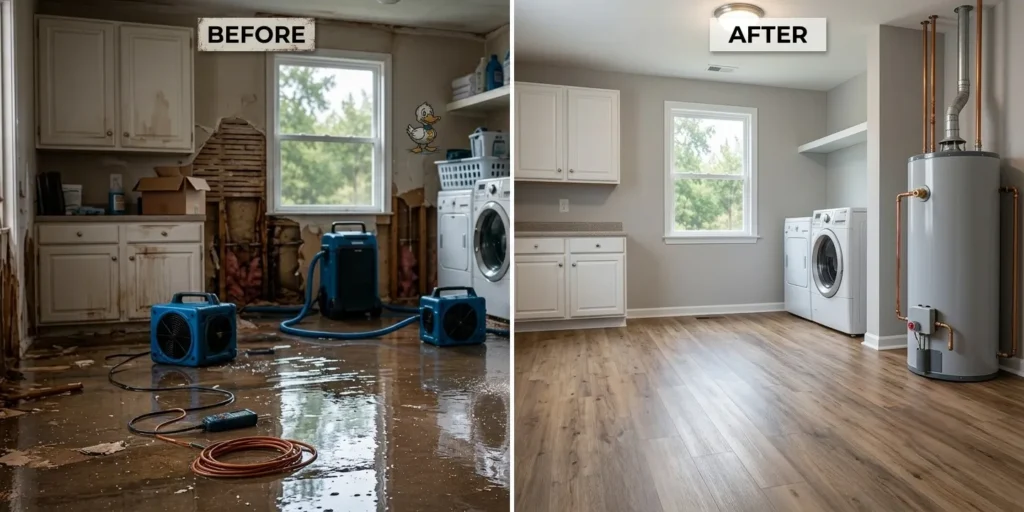
Water Mitigation Service Atlanta Ga, Step By Step Process?
Water mitigation refers to the emergency actions taken to stop ongoing water damage and prevent secondary issues like mold growth, structural weakening, and contamination spread. It is distinct from, but the essential first phase of, full water damage restoration. Mitigation typically includes:
- Identifying and (where possible) stopping the source of water intrusion
- Rapid extraction of standing water
- Moisture mapping using thermal imaging and moisture meters
- Setting industrial drying equipment (air movers, dehumidifiers)
- Removing unsalvageable, saturated materials to prevent contamination spread
- Applying antimicrobial treatments to reduce mold risk
Under the ANSI/IICRC S500 Standard, the industry’s foundational reference for water damage response, mitigation decisions are guided by two intersecting classification systems: Category (contamination level, from Category 1 clean water to Category 3 grossly contaminated black water) and Class (volume and drying difficulty, Class 1 through Class 4). Getting this classification right on day one shapes every decision that follows, from the equipment used to the safety protocols required for technicians and occupants.
Why Atlanta’s Climate Makes Mitigation Timing Especially Critical
Metro Atlanta sits in a humid subtropical climate zone, which means elevated ambient humidity is a near-constant companion for much of the year, especially during the long, wet summer season. This has two direct implications for water mitigation:
- Faster category degradation: Clean, Category 1 water can begin absorbing contaminants and supporting microbial growth more quickly when ambient humidity is already high, shortening the safe window for mitigation.
- Slower natural drying: Without professional dehumidification, wet materials in Atlanta’s humid air take significantly longer to dry naturally than they would in an arid climate, increasing the risk of secondary mold damage the longer mitigation is delayed.
This is why Air Drop Water Restoration treats every water mitigation call across metro Atlanta as time-sensitive, deploying commercial-grade extraction and drying equipment calibrated to local humidity and temperature conditions rather than one-size-fits-all protocols.
The Water Mitigation Process at Air Drop Water Restoration
Step 1: Emergency Response & Safety Assessment
Technicians arrive, assess electrical and structural safety, and begin containment of the affected area to prevent water migration into unaffected rooms.
Step 2: Moisture Mapping
Using non-invasive and penetrating moisture meters alongside thermal imaging cameras, technicians create a precise map of where moisture has traveled, often revealing damage far beyond what’s visible to the eye.
Step 3: Extraction
Truck-mounted and portable extraction units remove standing water quickly, minimizing the time contaminated or clean water sits in contact with building materials.
Step 4: Structural Drying
Air movers and dehumidifiers are positioned according to psychrometric principles, balancing airflow, temperature, and humidity to maximize evaporation rates from framing, subfloor, drywall, and flooring.
Step 5; Antimicrobial Application
EPA-registered antimicrobial treatments are applied to reduce the likelihood of mold colonization, particularly important given Georgia’s climate.
Step 6: Monitoring & Documentation
Moisture readings are tracked daily until materials reach an acceptable dry standard, with full documentation provided for insurance purposes.
Residential vs. Commercial Water Mitigation in Atlanta
Homeowners in neighborhoods like Grant Park, Buckhead, Virginia-Highland, and East Atlanta face different mitigation needs than commercial properties in Midtown, Downtown, or the industrial corridors near Hartsfield-Jackson Atlanta International Airport in Clayton County. Commercial water mitigation often involves:
- Coordinating around business hours or 24/7 operations
- Protecting sensitive equipment, inventory, and server rooms
- Larger-scale drying operations across warehouses or multi-unit buildings
- More complex insurance and property management communication chains
Air Drop Water Restoration structures its mitigation response to scale appropriately, whether the job is a single flooded bathroom in Smyrna or a multi-floor commercial flood in downtown Atlanta.
Metro Atlanta Coverage Area
Air Drop Water Restoration provides water mitigation services throughout Fulton County (Atlanta, Alpharetta, Roswell, Sandy Springs, Johns Creek, College Park), DeKalb County (Decatur, Dunwoody, Brookhaven, Tucker, Stone Mountain), Cobb County (Marietta, Smyrna, Kennesaw, Acworth, Powder Springs), Gwinnett County (Lawrenceville, Duluth, Norcross, Buford, Snellville), and Clayton County (Jonesboro, Forest Park, Riverdale), with additional response coverage extending into Henry, Rockdale, Douglas, Cherokee, Fayette, and Coweta counties.
Frequently Asked Questions About Water Mitigation Service in Atlanta Ga
Water Mitigation Atlanta: The Critical First Step Between Disaster and Full Recovery
Water mitigation is the emergency response phase focused on stopping ongoing damage, extraction, drying, and containment. Water damage restoration includes mitigation plus the full repair process to return a property to pre-loss condition.
Water Mitigation Service Atlanta Ga: 24/7 Emergency Response
How quickly does water mitigation need to happen after a flood or leak?
Ideally within hours. Industry guidance suggests that clean water can begin degrading into contaminated water within 24 to 48 hours, and mold growth risk rises significantly after the same window, especially in humid climates like Atlanta’s.
Water Mitigation Service Atlanta Ga: 24/7 Emergency Response.
Does homeowner’s insurance cover water mitigation in Atlanta?
Most policies cover mitigation costs when the water damage results from a sudden, accidental event like a burst pipe, though coverage for flood-related water damage typically requires separate flood insurance.
Water Mitigation Service Atlanta Ga: 24/7 Emergency Response.
What equipment is used in professional water mitigation?
Common equipment includes truck-mounted and portable extraction units, commercial air movers, industrial dehumidifiers, thermal imaging cameras, and both non-invasive and penetrating moisture meters.
Water Mitigation Service Atlanta Ga: 24/7 Emergency Response.
Can I do water mitigation myself with a shop vac and fans?
For very small, contained spills, basic cleanup may be sufficient. However, hidden moisture behind walls, under flooring, or within insulation is extremely difficult to detect and dry without professional equipment, and incomplete drying often leads to mold problems later.
Water Mitigation Service Atlanta Ga: 24/7 Emergency Response.
How long does the water mitigation process typically take?
A small, contained Class 1 loss might be resolved in 2–3 days. Larger Class 3 or Class 4 losses involving saturated structural materials can take a week or more of continuous monitoring and drying.
Water Mitigation Service Atlanta Ga: 24/7 Emergency Response.
What areas of metro Atlanta does Air Drop Water Restoration serve for mitigation services?
Air Drop Water Restoration responds throughout Fulton, DeKalb, Cobb, Gwinnett, and Clayton counties, along with surrounding communities in Henry, Rockdale, Douglas, Cherokee, Fayette, and Coweta counties.
Water Mitigation Service Atlanta Ga: 24/7 Emergency Response.
Why does Atlanta’s climate make water mitigation more urgent than in drier regions?
Atlanta’s humid subtropical climate slows natural evaporation and accelerates the timeline for contamination and mold growth, meaning delays in mitigation carry higher risk of secondary damage compared to drier climates.
Water Mitigation Service Atlanta Ga: 24/7 Emergency Response.
Stop the Damage Before It Spreads. Request Water Mitigation Service in Atlanta Today.