 Skip to content
Discovering mold in your Atlanta home or business? This guide explains how a professional mold removal service works, what causes mold growth in Georgia’s humid climate, and how to protect your health, home, and insurance claim.
Table of Contents
A professional mold removal service is not a luxury in metro Atlanta, it is often a health and safety necessity. Georgia’s humid subtropical climate, marked by long, muggy summers, frequent rainfall, and homes that trap moisture behind drywall and insulation, creates near-ideal conditions for mold colonization. According to the EPA, mold can begin growing on damp materials within 24 to 48 hours, which means the small water stain you noticed last week could already represent an active mold colony behind your wall.
Whether you have discovered visible mold in a bathroom in Roswell, a musty smell in a basement in Stone Mountain, or a water-damaged ceiling in a commercial building in Duluth, understanding how a legitimate mold removal service actually works, and how to tell a qualified remediation company from an unqualified one, protects both your property value and your family’s or employees’ health.
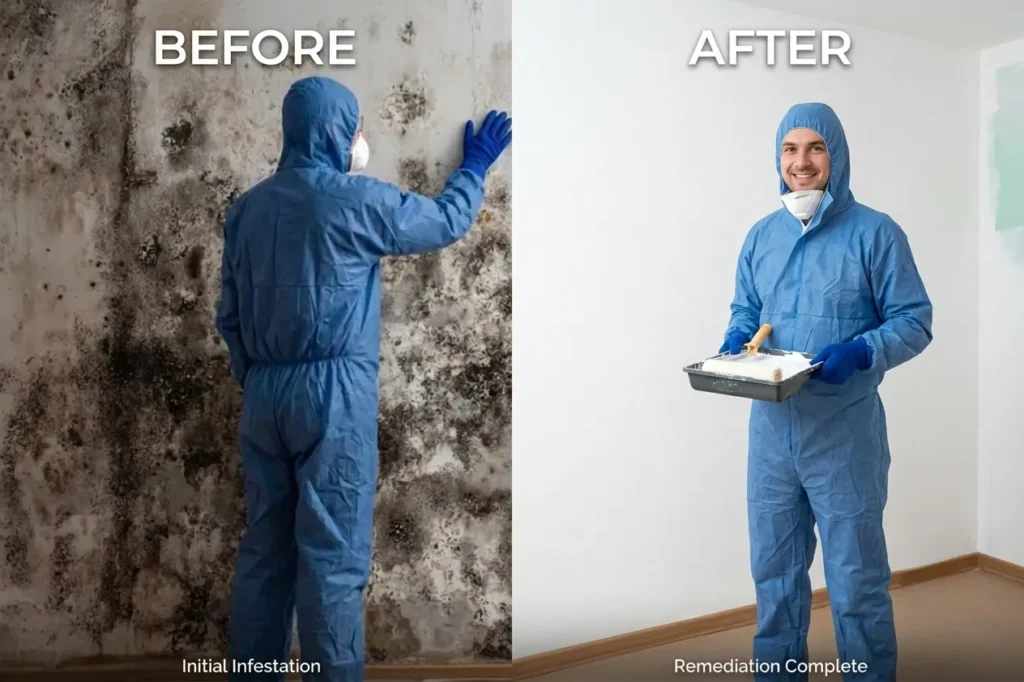
What Is Mold Remediation, and How Is It Different From Cleaning
Mold remediation is the professional process of identifying the source of moisture causing mold growth, containing the affected area to prevent spore spread, removing mold-contaminated materials that cannot be salvaged, and treating remaining surfaces, followed by verification testing to confirm the space is safe. Simple surface cleaning with bleach or household products does not address the underlying moisture source and often fails to eliminate mold at the root level.
A genuine mold removal service follows industry protocols, most notably those established by the IICRC S520 standard for professional mold remediation, rather than a generic cleaning checklist.
Why Atlanta’s Climate Makes Mold Growth So Common
Metro Atlanta’s combination of high summer humidity, heavy seasonal rainfall, and homes with basements, crawl spaces, and HVAC systems that generate condensate creates persistent moisture sources throughout the year. Common contributing factors across Fulton, DeKalb, Cobb, and Gwinnett counties include:
- Poorly ventilated crawl spaces in older homes throughout Decatur and East Atlanta
- HVAC condensate line clogs common in homes across Alpharetta and Johns Creek
- Roof leaks following severe summer thunderstorms
- Basement moisture intrusion in homes throughout Dunwoody and Sandy Springs
- Bathroom and kitchen ventilation issues in multi-family properties across Marietta and Smyrna.
Signs You Need a Professional Mold Removal Service
- Visible mold growth on walls, ceilings, or around windows
- A persistent musty odor, even in areas with no visible mold
- Recent water damage that was not fully dried within 24 to 48 hours
- Unexplained allergy-like symptoms that improve when you leave the building
- Warped drywall, peeling paint, or discoloration near plumbing fixtures
- Condensation buildup on windows or in crawl spaces
Read our Mold Remediation Guide
The Professional Mold Removal Process, Step by Step
- Inspection and testing: Technicians assess visible mold and use moisture meters to identify hidden sources
- Containment: Physical barriers and negative air pressure prevent spores from spreading to unaffected areas
- Air filtration: HEPA air scrubbers capture airborne mold spores during remediation
- Removal of contaminated materials: Porous materials like drywall and insulation that cannot be cleaned are removed and disposed of properly
- Cleaning and treatment: Remaining surfaces are cleaned with antimicrobial treatments
- Drying: Commercial-grade dehumidification ensures the underlying moisture source is fully resolved
- Verification testing: Post-remediation testing confirms mold levels have returned to normal, acceptable ranges
- Restoration: Removed materials are rebuilt or replaced to restore the space to pre-damage condition.
Found mold in your Atlanta home or business? Schedule a professional mold inspection with Air Drop Water Restoration today.
Health Risks Associated With Untreated Mold Exposure
According to the CDC, exposure to mold can trigger allergic reactions, respiratory irritation, and asthma symptoms, particularly in individuals with existing respiratory conditions or compromised immune systems. While reactions vary from person to person, the CDC and EPA both recommend prompt remediation of any significant mold growth rather than attempting to assess health risk without professional testing.
DIY Mold Removal vs. Professional Mold Removal Service
| Factor | DIY Mold Removal | Professional Mold Removal Service |
| Addresses moisture source | Rarely | Always, as a required first step |
| Prevents spore spread | No containment used | Full containment and HEPA filtration |
| Effective on porous materials | Limited | Contaminated materials properly removed |
| Verification testing | Not typically performed | Post-remediation clearance testing |
| Insurance documentation | Minimal | Full moisture logs and photo documentation |
| Long-term regrowth risk | High | Significantly reduced |
The EPA specifically advises that mold covering an area larger than approximately 10 square feet should be handled by a professional mold removal service rather than DIY methods, due to the risk of improper containment spreading spores throughout the property.
Mold Removal Cost Factors in Metro Atlanta
Mold removal service costs vary based on several factors:
- The total square footage of affected area
- Whether mold has spread into HVAC systems or wall cavities
- The type and porosity of contaminated materials
- Whether the underlying moisture source requires plumbing or structural repair
- Post-remediation testing and clearance requirements
A detailed, itemized estimate from a licensed mold removal service should break down inspection, containment, removal, treatment, and restoration costs separately.
Request a Mold Inspection Estimate
Mold and Your Insurance Policy
Mold coverage under homeowners insurance in Georgia typically depends on the cause. Mold resulting from a sudden, accidental event, such as a burst pipe, is more likely to be covered than mold resulting from long-term neglect or unresolved maintenance issues. Documentation is critical:
- Photograph mold growth and any related water damage immediately
- Retain a written mold inspection and testing report
- Keep a clear timeline of when the water intrusion was first discovered
- Work with a mold removal service experienced in coordinating directly with insurance adjusters
Not sure if your mold damage is covered by insurance? Air Drop Water Restoration will document everything and work directly with your adjuster.
Frequently Asked Questions About Mold Removal Service in Atlanta, GA
What does a professional mold removal service actually do?
A professional mold removal service inspects and tests for mold, contains the affected area, removes contaminated materials, treats remaining surfaces, dries the underlying moisture source, and performs verification testing to confirm the space is safe.
How much does a mold removal service cost in Atlanta?
Cost depends on the affected square footage, material type, and whether structural or plumbing repairs are needed. A reputable mold removal service provides a detailed, itemized estimate before beginning work.
Can I remove mold myself instead of hiring a mold removal service?
The EPA recommends professional remediation for mold covering more than approximately 10 square feet, since DIY methods often fail to address the underlying moisture source and can spread spores without proper containment.
How long does professional mold removal take?
Timelines vary by scope, but most residential mold removal projects take between two and five days, including inspection, containment, removal, treatment, and drying.
Does homeowners insurance cover mold removal service costs?
Coverage often depends on whether the mold resulted from a sudden, accidental event or long-term neglect. Proper documentation and a professional inspection report significantly strengthen a mold-related insurance claim.
What are the warning signs I need a mold removal service?
Visible mold, persistent musty odors, recent unresolved water damage, and unexplained allergy-like symptoms that improve away from the property are all signs a professional inspection is warranted.
Is black mold more dangerous than other types of mold?
Certain mold species, sometimes referred to as black mold, are associated with more significant health concerns, but the CDC advises that any substantial mold growth should be treated seriously and addressed by a professional, regardless of color or species.
What areas does Air Drop Water Restoration serve for mold removal service?
Air Drop Water Restoration provides mold testing and remediation across Atlanta, Sandy Springs, Marietta, Roswell, Alpharetta, Johns Creek, Dunwoody, Brookhaven, Decatur, Lawrenceville, Duluth, and surrounding communities throughout Fulton, DeKalb, Cobb, Gwinnett, Clayton, Henry, Rockdale, Douglas, Cherokee, Fayette, and Coweta counties.
Conclusion on Mold Removal Service in Atlanta, GA
Mold is not just a cosmetic problem in Atlanta’s humid climate, it is a health and structural issue that requires certified, professional remediation rather than a surface-level fix. A legitimate mold removal service addresses the underlying moisture source, contains spore spread, safely removes contaminated materials, and verifies the space is clean before calling the job complete. Air Drop Water Restoration brings exactly that level of rigor to every mold removal project across metro Atlanta.
Don’t let mold spread another day. Contact Air Drop Water Restoration for certified mold testing and remediation across metro Atlanta.