 Skip to content

Emergency water extraction flooded basement in Atlanta Metro calls start the same way. The phone rings at 2 a.m. after a storm. There is water on the stairs. The carpet squishes. The homeowner is scared.
If that is you right now, take a breath. You can get through this.
The first hours decide how much of your basement can be saved. Fast water removal limits damage to drywall, flooring, framing, and belongings. It also reduces mold risk, odor, and repair cost.
This article gives you a clear plan. You will see what to do before help arrives, what a professional extraction crew actually does, and how to protect your home from the next storm.
We work in Stone Mountain, Tucker, Lithonia, Decatur, Smyrna, and across the Atlanta Metro. We have seen every kind of basement flood. Here is what matters most.
Basement Flooded Right Now? Call Before the Damage Spreads
Air Drop Water Restoration provides 24/7 emergency water extraction across Stone Mountain and the Atlanta Metro.
What Is Emergency Water Extraction for a Flooded Basement?
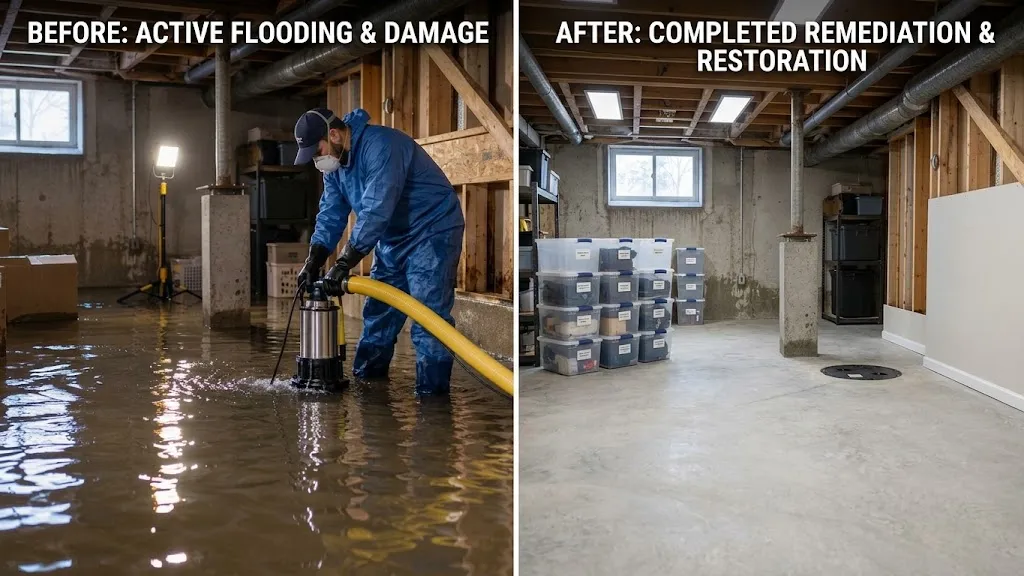
Emergency water extraction is the rapid removal of standing water from a flooded basement using truck-mounted or portable extractors, submersible pumps, and specialized tools, followed by moisture detection and structural drying. It is the first and most time-sensitive step of water damage mitigation.
Extraction alone does not dry a basement. It removes the bulk water. Materials such as concrete, framing, and drywall still hold moisture. Structural drying finishes the job.
Key Terms in Basement Flood Restoration
- Water mitigation: actions that stop further loss and limit damage.
- Extraction: removing standing and absorbed water.
- Structural drying: using air movers, dehumidifiers, and monitoring to return materials to dry standards.
- Moisture mapping: documenting wet areas with meters and thermal imaging.
- Flood cut: removing the lower section of drywall above the waterline.
- Category 3 water: grossly contaminated water that may contain sewage or flood contaminants.
- Antimicrobial treatment: applying approved products to limit microbial growth after cleaning.
Quick Answer: How Fast Should Basement Water Be Removed?
Start as soon as it is safe. Many restoration professionals aim to begin extraction within hours of the call. The EPA advises drying wet materials within 24 to 48 hours to prevent mold growth.
Safety First: Before Emergency Water Extraction in a Flooded Basement
Your safety matters more than your carpet. Basement floods create real hazards.
Electrical Danger
Water and electricity are deadly together. If water is near outlets, appliances, or your panel, do not walk into it.
- Turn off power at the main breaker only if the panel is dry and you can reach it safely.
- If the panel is in the flooded basement, call your utility and an electrician.
- Do not touch wet electrical equipment.
Contaminated Water
Basement floodwater can carry sewage, soil, chemicals, and bacteria. Assume it is contaminated until a professional says otherwise.
Structural Hazards
Soaked walls and ceilings can fail. Deep water adds heavy pressure to basement walls. One inch of water over 1,000 square feet weighs more than 5,000 pounds.
Carbon Monoxide Risk
Never run gas-powered pumps or generators inside the home or garage. Carbon monoxide can kill quickly.
Safety Checklist
- Keep children and pets out of the basement
- Do not enter standing water near electricity
- Wear rubber boots and gloves if you must go near wet areas
- Do not use a household vacuum on water
- Do not use gas-powered equipment indoors
- Call a professional for deep water or sewage
Emergency Water Extraction Flooded Basement in Atlanta Metro: What to Do While You Wait
Help is on the way. These steps protect your property and your insurance claim.
Step-by-Step: First Steps When Your Basement Floods
- Stop the source if you can. Close the main water valve if a pipe or water heater failed.
- Protect yourself. Follow the safety checklist above.
- Photograph and film everything. Capture water level, damaged items, and the source.
- Move valuables upstairs. Lift items you can carry safely.
- Remove small rugs and wet furniture if they are easy to move.
- Open windows only if weather allows. Do not open them during a storm.
- Do not turn on the HVAC. It can spread contaminants.
- Call a restoration company. Describe the water source, depth, and square footage.
- Call your insurance agent. Ask about coverage and claim steps.
What Not to Do
- Do not wait to see if it dries on its own
- Do not paint or cover wet surfaces
- Do not throw out damaged items before your adjuster approves
- Do not ignore sewage odors
Read our: Emergency Water Extraction Service to see what to expect when you call.
Why Emergency Water Extraction Flooded Basement in Atlanta Metro Homes Is Common
Atlanta basements flood for predictable reasons. Understanding them helps you protect your home.
Heavy Rain and Storm Surge
Atlanta receives frequent thunderstorms and tropical remnants. Intense rainfall can exceed what storm drains and gutters handle. Runoff then moves toward your foundation.
Georgia Red Clay
Much of the Piedmont has dense clay soil. Clay drains slowly and expands when wet, pressing on foundation walls. Cracks and cold joints let water in.
Sump Pump Failure
A sump pump is your last line of defense. They fail during storms because of power outages, stuck floats, clogged pits, or age. A battery backup can save a basement.
Poor Grading and Downspouts
If the soil slopes toward the house or downspouts dump water near the foundation, water finds the lowest point. In many homes, that is the basement.
Plumbing Failures
Burst pipes, water heater ruptures, washing machine hose failures, and failed supply lines can flood a basement fast.
Sewer Backups
During heavy rain, municipal sewer lines can back up. Sewage then enters through floor drains. This is Category 3 water and needs professional cleanup.
Creek and Low-Lying Properties
Homes near creeks, drainage channels, or low-lying lots in DeKalb, Cobb, Gwinnett, and Fulton counties face higher flood exposure. Monitor weather alerts with the National Weather Service Peachtree City office.
Emergency Water Extraction Flooded Basement in Atlanta Metro: Water Categories Explained
Not all water is the same. The category changes the safety plan, the equipment, and what materials can be saved.
IICRC Water Categories
| Category | Description | Basement Examples | Typical Response |
| Category 1 | Clean water from a sanitary source | Broken supply line, overflowing sink | Extract, dry in place when materials are salvageable |
| Category 2 | Gray water with significant contamination | Washing machine or dishwasher discharge, sump overflow | Extract, remove affected padding, clean, treat, and dry |
| Category 3 | Grossly contaminated water | Sewage backup, creek or river flooding, ground-surface flood water | Remove porous materials, clean, disinfect, and dry with strict safety controls |
Water Can Change Category Over Time
Clean water that sits for 48 to 72 hours can degrade. Bacteria multiply. Odors develop. That is another reason to call fast.
Water Classes in a Basement
- Class 1: minimal wetting, mostly non-porous materials
- Class 2: carpet, cushion, and lower walls wet
- Class 3: water absorbed through walls and ceilings
- Class 4: deep saturation of concrete, masonry, and hardwood requiring specialty drying
Most flooded finished basements are Class 2 or Class 3. Many Georgia basements have concrete and block walls that hold moisture for a long time.
For standards and training information, see the IICRC website.
How Professionals Handle Emergency Water Extraction in a Flooded Basement
Here is what happens when a professional crew arrives.
Step-by-Step: Our Emergency Extraction and Drying Process
- Safety assessment. We check electrical hazards, structural concerns, and contamination.
- Source control. If the source is still active, we help stop it.
- Water category and class assessment. We identify the right response plan.
- Bulk water extraction. Submersible pumps and truck-mounted extractors remove standing water.
- Carpet and pad extraction. We remove water from carpet. In many cases, pad is removed and discarded.
- Removal of non-salvageable materials. Wet drywall, insulation, and contaminated items are removed as needed.
- Moisture mapping. Moisture meters and thermal cameras document affected areas.
- Structural drying setup. We place air movers and dehumidifiers based on the dry plan.
- Cleaning and antimicrobial treatment. Surfaces are cleaned and treated when appropriate.
- Monitoring. We check readings daily until the structure meets drying goals.
- Documentation. We record photos, moisture logs, and equipment use for insurance.
- Repair and rebuild. We coordinate or complete the restoration.
Equipment You May See
| Equipment | What It Does |
| Submersible pumps | Move large volumes of standing water out quickly |
| Truck-mounted or portable extractors | Remove water from carpet, pad, and flooring |
| Air movers | Increase airflow across wet surfaces |
| LGR and desiccant dehumidifiers | Pull moisture out of the air and materials |
| Moisture meters | Measure moisture content in building materials |
| Thermal imaging cameras | Show cool, wet areas behind surfaces |
| HEPA air scrubbers | Filter airborne particles during cleanup |
Why Drying Time Matters
A basement may need several days of drying. Concrete and framing release water slowly. Stopping early invites mold.
Get Professional Extraction and Drying in Stone Mountain and Beyond
Our crews arrive ready with pumps, extractors, air movers, dehumidifiers, and moisture detection tools.
Emergency Water Extraction Flooded Basement in Atlanta Metro: What Can Be Saved?
Homeowners always ask what can be saved. The honest answer depends on the water category, the time elapsed, and the material.
Materials and Typical Outcomes
| Material | Clean Water (Category 1) | Contaminated Water (Category 2 or 3) |
| Carpet | Often salvageable if extracted quickly | Usually removed |
| Carpet pad | Often replaced | Removed |
| Drywall | Sometimes dried in place | Usually cut out above the waterline |
| Insulation | May be replaced | Removed |
| Concrete slab | Dried and cleaned | Cleaned, disinfected, and dried |
| Solid wood furniture | Often salvageable | Case by case |
| Upholstery | Case by case | Often discarded |
| Electronics | Do not power on. Seek evaluation | Usually discarded |
| Cardboard boxes | Often discarded | Discarded |
Contents Handling
Take photos of damaged items. Keep a list. Your adjuster may need it. We help you sort what can be cleaned and what must go.
Documents and Photos
Wet paper and photographs can sometimes be stabilized by freezing. Ask about document drying if irreplaceable items were affected.
Emergency Water Extraction Flooded Basement in Atlanta Metro: The First 72 Hours Timeline
Speed changes the outcome. This timeline shows why.
| Time After Flooding | What Is Happening in the Basement | Best Action |
| 0–4 hours | Water spreads across the slab. Carpet and pad absorb it. Drywall begins to wick. | Stop the source. Stay safe. Call for emergency extraction |
| 4–24 hours | Wicking climbs the walls. Wood swells. Odors start. Metal begins to rust. | Extract bulk water. Remove pad. Set drying equipment |
| 24–48 hours | Mold spores can begin to germinate. Bacteria multiply in contaminated water. | Complete cleaning. Monitor moisture daily |
| 48–72 hours | Visible mold may appear. Materials may become non-salvageable. | Remove failed materials. Continue structural drying |
| After 72 hours | Odors, microbial growth, and secondary damage are likely. | Remediation and expanded repairs may be needed |
Hidden Damage Many Homeowners Miss
- Water behind baseboards and wall cavities
- Wet insulation that stays soaked for weeks
- Saturated subfloor under finished flooring
- Moisture in block walls and concrete slabs
- Water in electrical boxes and HVAC components
- Wet furnace or water heater platforms
Moisture mapping finds these hidden areas. Without it, a basement can look dry and still hide a mold problem.
Emergency Water Extraction Flooded Basement in Atlanta Metro: Finished, Unfinished, and Walkout Basements
Different basements need different plans.
Unfinished Basements
These often have bare concrete and block walls. Extraction is usually simpler. Drying focuses on the slab, wall bases, and stored belongings. We pay close attention to wood framing and sill plates.
Finished Basements
Finished spaces have carpet, pad, drywall, trim, cabinets, and sometimes bathrooms. Water gets trapped behind wall finishes. Extraction is only the beginning. Controlled demolition may be needed to reach wet cavities.
Walkout Basements
Many Atlanta Metro homes are built on sloped lots with walkout basements. Door thresholds and exterior grading are common intrusion points. After heavy rain, check the door sweep and the soil level at the threshold.
Basements With a Bathroom or Laundry
Supply line leaks and drain failures are more likely in these spaces. They can also be a source of Category 2 water.
Basement Apartments and Rental Units
Fast action matters here. Occupants may need temporary relocation. Documentation protects owners and tenants.
What Affects the Cost
We will not guess a price in an article. Every flood is different. These factors drive it:
- Depth and square footage of water
- Water category
- Time since the loss
- Types of flooring and wall finishes
- Amount of demolition required
- Equipment days for drying
- Contents handling needs
- Rebuild scope
A free assessment and a written scope give you real numbers.
Emergency Water Extraction Flooded Basement in Atlanta Metro: Insurance and Claims
Insurance can be confusing. Here is the basic picture. We are not insurance adjusters or attorneys. Read your policy and talk with your agent.
Standard Homeowners Policies
Many policies cover sudden and accidental discharge, such as a burst pipe or water heater failure. Many exclude damage from surface flooding or rising groundwater.
Flood Insurance
Flood coverage is typically a separate policy. The National Flood Insurance Program offers policies through participating insurers. There is generally a waiting period before coverage begins. Learn more at FEMA’s flood insurance resources. External Link Opportunity: link to the National Flood Insurance Program page.
Water Backup Endorsements
Sewer and sump backup often need an add-on endorsement. If your basement has floor drains or a sump pump, ask your agent about this coverage.
How to Support Your Claim
- Photograph and video all damage before cleanup
- Save damaged items until the adjuster approves disposal
- Keep receipts for emergency services and temporary repairs
- Record dates and times
- Request moisture logs and equipment records from your restoration company
- Communicate with your adjuster in writing
What We Do
Air Drop Water Restoration documents the loss and supports you through the claim process. We provide clear scopes, photos, and drying records.
Read our: Water Damage Restoration Services for full-service mitigation and rebuild.
Emergency Water Extraction Flooded Basement in Atlanta Metro: DIY Versus Professional
Some homeowners start with a wet vac and fans. That can work for a very small spill. A flooded basement is different.
| Factor | DIY | Professional Emergency Extraction |
| Volume | Wet vacs handle small amounts | Pumps and extractors handle hundreds or thousands of gallons |
| Speed | Slow | Rapid |
| Contamination safety | Limited | Training and protective equipment |
| Moisture detection | Guesswork | Meters and thermal imaging |
| Structural drying | Household fans only | Air movers and dehumidifiers with monitoring |
| Mold prevention | Uncertain | Planned drying and antimicrobial treatment |
| Insurance records | Limited | Detailed documentation |
| Risk of hidden damage | High | Lower |
When DIY Is Not Enough
- Water deeper than a few inches
- Any sewage or gray water
- Water touching electrical outlets
- Wet drywall or insulation
- Multiple rooms affected
- You cannot dry within 24 to 48 hours
Real Contractor Advice
We often meet homeowners who removed the carpet and ran a fan for a week. The slab felt dry. The walls were still wet. A month later, mold appeared. Professional moisture mapping would have found it on day one.
Do Not Gamble With Your Basement
Call a team that dries the structure and documents the job. Call +1 (678)-374-9247 for emergency water extraction in Stone Mountain and the metro.
Local Flood Risks for Emergency Water Extraction in Stone Mountain and the Atlanta Metro
Local conditions shape basement flood risk.
Stone Mountain and DeKalb County
Many homes sit on sloped lots with clay soil. Storm runoff moves quickly toward lower floors. Older homes may have outdated waterproofing, aging gutters, or limited drainage.
Tucker, Lithonia, and Conyers
Finished basements, walkouts, and crawl spaces are common. Sump pump reliability is a major factor.
Decatur and Brookhaven
Older homes and mature trees can mean root intrusion in lateral lines and aging drain systems.
Smyrna, Marietta, and Kennesaw
Homes near creeks and low-lying areas can see groundwater seepage after extended rain. Municipal sewer capacity can be strained during storms.
Southside Communities
East Point, College Park, Union City, and Fayetteville see intense storms and older housing stock. Slab and crawl space moisture are common.
Storm Seasons
Spring severe weather and summer thunderstorms are common triggers. Tropical remnants in late summer and fall can bring prolonged rainfall. Winter freezes can also burst pipes and cause basement flooding.
For emergency preparedness, visit Georgia Emergency Management and Homeland Security and FEMA’s flood preparedness resources.
Preventing the Next Flooded Basement in the Atlanta Metro
You cannot control storms. You can control your home’s response.
Prevention Checklist
- Test your sump pump each season
- Install a battery backup or water-powered backup pump
- Clean gutters twice a year
- Extend downspouts at least several feet from the foundation
- Regrade soil to slope away from the house
- Seal foundation cracks
- Install a backwater valve on the sewer line if recommended
- Replace aging washing machine hoses
- Service the water heater yearly
- Keep storage items elevated off the floor
- Install water leak sensors
Seasonal Maintenance
Spring: Inspect the sump pump, gutters, and foundation after winter.
Summer: Watch for storm-driven water. Keep drains clear.
Fall: Clean leaves. Check roof and downspouts.
Winter: Insulate pipes. Learn where your main water shutoff is.
Expert Tips From Our Crew
- Label your main water shutoff and breaker panel
- Keep a flood kit with flashlight, gloves, boots, and our phone number
- Use plastic bins instead of cardboard in the basement
- Take dated photos of your basement every year
- Review your insurance coverage every year
Read our: 24/7 Mold Remediation Service if water sat in your basement for more than two days.
Why Atlanta Metro Homeowners Choose Air Drop Water Restoration
Air Drop Water Restoration specializes in water damage restoration, mold remediation, fire damage restoration, and emergency plumbing support. We build our business on quality and integrity.
What You Can Expect
- 24/7 emergency response. Floods do not follow business hours.
- Direct communication. You know the plan and the progress.
- Advanced equipment. Pumps, extractors, air movers, dehumidifiers, and moisture meters.
- Insurance support. We document and communicate clearly.
- Full-service restoration. From water extraction to rebuild coordination.
Related Services
Service Area
We serve Stone Mountain and the Atlanta Metro, including Atlanta, Sandy Springs, Marietta, Roswell, Alpharetta, Johns Creek, Dunwoody, Brookhaven, Decatur, Smyrna, Kennesaw, East Point, College Park, Union City, Douglasville, Mableton, Tucker, Lithonia, Conyers, Covington, Stockbridge, McDonough, Lawrenceville, Duluth, Suwanee, Peachtree City, Fayetteville, and Newnan.
Frequently Asked Questions About Emergency Water Extraction in a Flooded Basement
How fast should emergency water extraction start in a flooded basement in Atlanta Metro?
As soon as it is safe. Water spreads into drywall, framing, and flooring quickly. Mold can begin growing in 24 to 48 hours. Call a restoration company immediately.
How long does emergency water extraction take for a flooded basement?
Extraction itself may take a few hours for a typical basement. Structural drying often takes several days. Timing depends on water depth, contamination, materials, and humidity.
Is it safe to enter a flooded basement before emergency water extraction?
Not always. Electrical hazards, contamination, and structural concerns are real. Stay out if water is deep or near outlets, and call a professional.
Can I use a wet vac for emergency water extraction in a flooded basement?
A wet vac helps with a very small spill. It is not enough for a flooded basement, and it does not dry walls, framing, or concrete.
Does homeowners insurance cover emergency water extraction in a flooded basement in Georgia?
It depends on the cause of the water. Sudden and accidental plumbing failures are often covered. Surface flooding usually requires flood insurance. Sewer or sump backup usually needs an endorsement. Check your policy.
What happens if I wait to start emergency water extraction in my flooded basement?
Damage spreads. Drywall wicks water upward. Flooring warps. Mold may grow. Odors set in. Delay usually increases repair cost.
Do I need structural drying after emergency water extraction?
Yes. Extraction removes standing water but not moisture inside materials. Structural drying with air movers and dehumidifiers prevents mold and hidden damage.
Can a flooded basement in Atlanta Metro cause mold?
Yes. Warm, humid Georgia conditions make mold growth likely if materials stay wet. Fast extraction and drying lower the risk.
Who offers 24/7 emergency water extraction for a flooded basement near Stone Mountain?
Air Drop Water Restoration offers 24/7 emergency water extraction across Stone Mountain and the Atlanta Metro. Call +1 (678)-374-9247.
Act Fast on Emergency Water Extraction for Your Flooded Basement
Emergency water extraction flooded basement in Atlanta Metro homes needs speed, safety, and the right equipment. The sooner water is removed and the structure is dried, the more you can save.
Here is what to remember:
- Put safety first. Avoid electrical and contamination hazards.
- Stop the source and document the damage.
- Water category and class shape the plan.
- Extraction and structural drying work together.
- Insurance coverage depends on the cause of loss.
- Prevention starts with drainage, sump maintenance, and early leak detection.
You do not need to handle this alone. Air Drop Water Restoration brings trained crews, proven equipment, and honest communication to your door.
Flooded Basement? Get Emergency Water Extraction Now
Call Air Drop Water Restoration. We answer 24/7 and serve Stone Mountain, Tucker, Lithonia, Decatur, Smyrna, and the entire Atlanta Metro.