 Skip to content

Water in basement spaces is a Stone Mountain homeowner’s nightmare. You walk downstairs and your shoes splash. Boxes are floating. The carpet squishes. The air smells like wet earth.
Take a breath. You can handle this, and you do not have to do it alone.
This guide answers the question you are asking right now: who to call for water in basement emergencies near you. It also explains why basements flood, what to do in the first hour, how restoration works and how to stop it from happening again.
Air Drop Water Restoration is headquartered in Stone Mountain, GA. We have served Metro Atlanta since 2012. We are IICRC-certified, licensed and insured. Call +1 (678)-374-9247 and a crew heads your way.
Why a Restoration Company Comes First
Plumbers fix pipes. Waterproofers fix foundations. Neither one removes the water or dries your basement.
Air Drop Water Restoration handles the immediate problem. We extract water, dry the structure and stop mold. We can also connect you with plumbing and repair help through one team. See our water damage restoration service.
Quick Answer: Who Should I Call for Water in My Basement?
Call a certified water damage restoration company that offers 24/7 emergency water extraction, like Air Drop Water Restoration in Stone Mountain. They remove the water, dry the structure and document the loss for insurance.
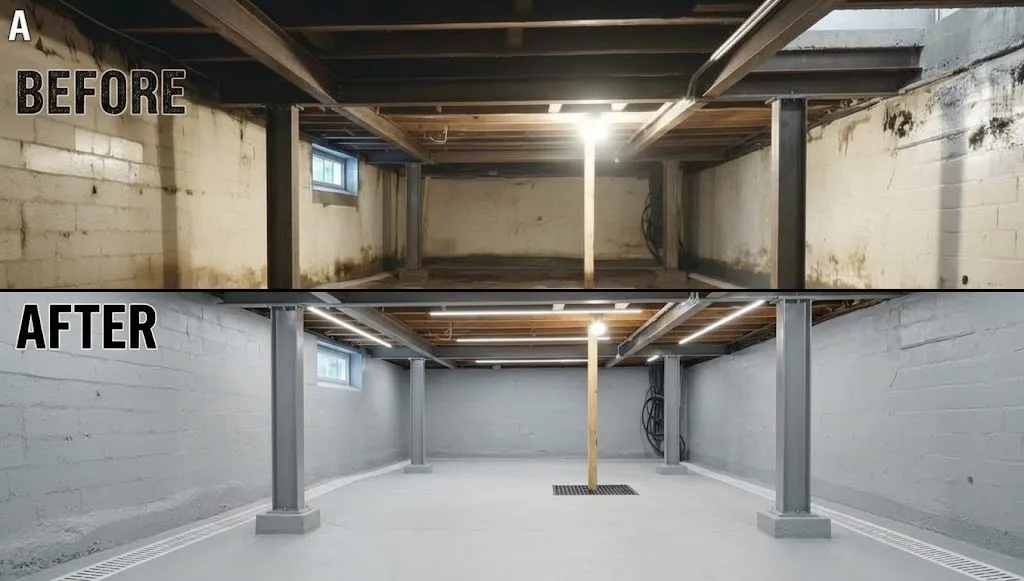
Water in your basement right now? Do not wait for it to drain on its own. Call Air Drop Water Restoration at +1 (678)-374-9247. Our Stone Mountain crew answers 24/7.
Water in Basement: What to Do in the First Hour
The first hour matters. Here is your safe action plan.
Safety First
- Stay out of the water if electrical outlets, cords or appliances are submerged. Water conducts electricity.
- Turn off power only from a dry location, and only if the panel is not in the water. If you are unsure, call your utility or an electrician.
- Do not use a vacuum or electric tools in standing water.
- Avoid contact if the water looks dark, smells like sewage or came from a drain.
Immediate Steps
- Identify the likely source: rain, pipe, water heater, sump pump or sewer.
- Shut off the main water valve if the source is plumbing.
- Move valuables upward if it is safe.
- Take photos and videos for insurance.
- Call Air Drop at +1 (678)-374-9247.
- Open your insurance claim.
What Not to Do
- Do not drain a flooded basement too quickly. Pumping out too fast can stress foundation walls if soil outside is still saturated. Professionals manage this carefully.
- Do not run your HVAC if sewage may be present.
- Do not mix cleaning chemicals.
- Do not leave wet carpet in place.
Why There Is Water in Basement Spaces Across Stone Mountain and Metro Atlanta
Understanding the cause helps you fix it for good.
Local Conditions That Drive Water in Basement Problems
- Heavy rainfall. Atlanta averages roughly 50 inches annually, according to the National Weather Service Peachtree City office. Intense downpours overwhelm drainage.
- Red clay soil. Georgia’s Piedmont clay drains slowly and holds water against foundation walls.
- Sloped lots. Many Stone Mountain and DeKalb County properties sit on hills. Runoff flows toward homes.
- Granite bedrock nearby. Shallow rock formations can channel groundwater unpredictably.
- Aging homes. Older waterproofing, clay drain tile and original sump systems fail over time.
- Storm seasons. Spring thunderstorms and tropical remnants dump large volumes in short periods.
Common Causes of Water in Basement
| Cause | How It Happens | Typical Signs |
| Hydrostatic pressure | Saturated soil pushes water through walls and floor | Seepage at the wall-floor joint |
| Failed sump pump | Pump dies during a storm or power outage | Standing water, pump not running |
| Cracked foundation | Settling creates cracks | Water streaks or active leaks in walls |
| Poor grading | Ground slopes toward the house | Water pools near foundation outside |
| Clogged gutters and downspouts | Roof water dumps beside the foundation | Overflow lines on siding |
| Window well flooding | Wells fill and spill into the window | Water under basement windows |
| Burst or leaking pipe | Supply or drain line fails | Flowing water, ceiling stains |
| Water heater failure | Tank ruptures | Water around the heater |
| Sewer backup | Municipal line or lateral clogs | Dark water, sewage odor, floor drain overflow |
Hydrostatic Pressure Explained
Hydrostatic pressure is the force of groundwater pushing against your foundation. When soil saturates, the water has nowhere to go but through the weakest point: cracks, joints and floor slabs.
This is why basements often flood even when your roof and gutters are fine.
Types of Water in Basement: Why the Source Changes Everything
Not all basement water is equal. Professionals classify it using IICRC categories. See IICRC for the standards.
| Category | Source | Risk | Action |
| Category 1 | Clean supply line or water heater | Low | Extract and dry |
| Category 2 | Gray water from appliances or sump discharge | Moderate | Extract, clean, sanitize, possible material removal |
| Category 3 | Black water: sewage, floodwater, groundwater intrusion | High | Full remediation, remove porous materials, disinfect |
Is Rainwater Entering a Basement Clean?
No. Groundwater and surface runoff pick up soil, bacteria and chemicals. Many restoration professionals treat floodwater as Category 3 because of that contamination.
Warning Signs of Contaminated Water
- Dark or cloudy color
- Sewage or sulfur odor
- Floor drain overflow
- Oily sheen
- Debris or solids
If you see these, do not touch the water. Call us. Our sewage backup cleanup service is built for biohazard-safe cleanup.
How Air Drop Removes Water in Basement Spaces: The Restoration Process
Here is exactly what happens when you call us.
Step 1: 24/7 Emergency Dispatch
We answer. We ask about the water source, depth and safety concerns. A crew is on the way.
Step 2: Safety Assessment
Technicians check for electrical hazards, structural concerns and contamination. We wear PPE when needed.
Step 3: Water Extraction
We use submersible pumps, truck-mounted extractors and portable units to remove standing water. Controlled extraction protects your foundation.
Step 4: Moisture Detection
We use moisture meters and thermal imaging cameras to map wet drywall, studs, subfloor and concrete.
Step 5: Removal of Unsalvageable Materials
Saturated carpet, pad, insulation and damaged drywall often must go. Removing them speeds drying and reduces mold risk.
Step 6: Structural Drying and Dehumidification
Basements are naturally humid. Professional-grade dehumidifiers and air movers control the environment. Concrete and block walls need specialty drying.
Step 7: Cleaning, Sanitizing and Deodorizing
We clean surfaces and apply antimicrobial treatments to control bacteria and mold.
Step 8: Monitoring
Technicians return to take readings. We keep equipment running until materials meet dry standards.
Step 9: Mold Check and Remediation
If mold is present, we set containment and remove it safely. Learn more about our mold remediation service.
Step 10: Restoration and Reconstruction
We rebuild drywall, trim, flooring and finishes. One team, one plan.
Local crew. Fast response. Air Drop is based in Stone Mountain. Call +1 (678)-374-9247 and ask for a free on-site assessment.
How Fast Mold Grows With Water in Basement
Basements are mold friendly. They are dark, cool and often humid.
The EPA says mold can begin to grow on wet materials within 24 to 48 hours. See the EPA mold guidance.
What Feeds Mold in a Basement
- Wet drywall and paper facing
- Carpet and pad
- Wood framing
- Cardboard boxes
- Insulation
- Stored fabrics and books
Signs of Mold After Basement Flooding
- Musty, earthy smell
- Black, green or white spots on walls or boxes
- Peeling paint or bubbling drywall
- Condensation on walls
- Increased allergy or breathing symptoms
The CDC explains potential health effects of mold exposure, including respiratory irritation for some people.
The 24-48-72 Rule
| Time Since Flooding | What Is Happening |
| 0 to 24 hours | Best window for extraction and drying |
| 24 to 48 hours | Mold can begin, odors start |
| 48 to 72 hours | Mold spreads, materials begin to fail |
| Beyond 72 hours | Expect remediation and material removal |
Water in Basement Insurance Claims in Georgia
Basement flooding and insurance can get complicated. Here is a plain-language overview.
What Is Often Covered
- Sudden pipe bursts
- Water heater ruptures
- Sudden appliance failures
- Water entering from storm-damaged roofs or windows
What Is Often Not Covered
- Surface flooding and rising groundwater
- Seepage through foundation walls
- Sewer and drain backup without an endorsement
- Gradual leaks and lack of maintenance
Flood Insurance
Standard homeowners policies typically exclude flooding. Flood coverage is available through the National Flood Insurance Program and private insurers. There is often a waiting period, so do not wait until a storm is forecast.
Sewer and Water Backup Endorsement
Many Georgia homeowners add this endorsement. It can cover water in basement events from backed-up drains and sump failure. Ask your agent.
How to Protect Your Claim
- Photograph and video before cleanup.
- Document the water line on walls.
- Keep damaged items until the adjuster reviews them.
- Save receipts.
- Get moisture logs from your contractor.
- Report the loss quickly.
For consumer guidance, visit the Georgia Office of Insurance and Safety Fire Commissioner.
Water in Basement: Who Pays and Who Repairs?
Responsibilities vary by situation.
| Situation | Typically Responsible |
| Homeowner, covered burst pipe | Homeowner policy |
| Homeowner, groundwater seepage | Homeowner (flood policy if purchased) |
| Renter, building plumbing failure | Landlord for the structure, renter’s policy for belongings |
| Condo, upstairs unit leak | HOA master policy or responsible unit owner’s policy |
| City sewer main backup | Varies, sometimes the municipality after investigation |
Not sure? Call us. We can help you understand the next step and document the loss.
Water in Basement vs. Water in Crawl Space
Many Stone Mountain homes have crawl spaces rather than full basements. The risks are similar but the access is harder.
- Crawl spaces hold moisture against floor joists and subfloors.
- Vapor barriers can fail.
- Standing water attracts pests.
- Mold can spread upward into the living space.
Our crews also handle crawl space extraction and drying.
Expert Tips to Prevent Water in Basement Again
Prevention is a lot cheaper than cleanup.
Outside Fixes
- Clean gutters at least twice a year.
- Extend downspouts 4 to 6 feet away from the foundation.
- Regrade soil so it slopes away from the house.
- Keep window wells clear and covered.
- Avoid planting beds that trap water against the foundation.
Inside Fixes
- Test your sump pump every few months by pouring water into the pit.
- Install a battery backup for the sump pump.
- Seal visible foundation cracks (professionally if they are wide or growing).
- Use a dehumidifier to keep basement humidity under about 50 percent.
- Store items on shelves, not directly on the floor.
- Use plastic bins instead of cardboard boxes.
- Install a water alarm near the sump and floor drain.
Long-Term Solutions
| Solution | What It Does |
| Interior drain tile and sump system | Collects water at the footing and pumps it out |
| Exterior waterproofing membrane | Blocks water at the foundation wall |
| French drain | Redirects surface and groundwater away |
| Backwater valve | Prevents sewer backup into the home |
| Crawl space encapsulation | Seals vapor and moisture from the ground |
Contractor Advice From the Field
We often arrive after a sump pump fails during a storm. The pump was old, the power was out and no backup existed. A battery backup costs far less than a flooded basement.
Another tip. If your basement smells musty even when it is dry, you likely have a moisture issue. Call for an inspection before it becomes mold.
Schedule a moisture inspection. Musty smell or damp walls? Call Air Drop Water Restoration at +1 (678)-374-9247 before a small problem becomes a big one.
Featured Snippet: Water in Basement Checklist
Use this quick checklist when you discover water in your basement.
- Stay out of the water if electricity is near
- Shut off the main water valve if a pipe is leaking
- Photograph and video everything
- Call a 24/7 restoration company
- Open an insurance claim
- Move valuables upward if safe
- Do not run the HVAC if sewage is possible
- Do not use household vacuums
- Keep pets and children away
- Keep records and receipts
DIY vs. Professional Help for Water in Basement
A shop vac and a few fans might handle a small clean-water spill. Anything beyond that is a different story.
| Factor | DIY | Air Drop Water Restoration |
| Extraction | Shop vac, mop | Truck-mounted and submersible pumps |
| Moisture detection | Guesswork | Meters, thermal imaging |
| Drying | Fans, household dehumidifier | Professional air movers and dehumidifiers |
| Contamination | Household cleaner | Antimicrobials, containment, PPE |
| Mold prevention | Often missed | Monitoring and remediation |
| Insurance support | None | Photos, logs, estimates |
| Warranty | None | One year warranty on our services |
When DIY Becomes Risky
- Water deeper than a few inches
- Water that is dark or smells like sewage
- Water that has sat more than 24 hours
- Wet drywall or insulation
- Anyone in the home with asthma or allergies
Why Stone Mountain Homeowners Trust Air Drop for Water in Basement Emergencies
We are not a call center in another state. We live here.
- Based in Stone Mountain, GA. Fast local response.
- 24/7 emergency service.
- IICRC-certified technicians.
- Licensed and insured.
- Direct service without intermediaries.
- Free on-site assessments.
- One year warranty on our services.
- Serving Metro Atlanta since 2012.
- Water, mold, fire, sewage and plumbing from one team.
Neighborhoods and Cities Near Stone Mountain We Serve
Stone Mountain, Tucker, Lithonia, Decatur, Conyers, Covington, Lawrenceville, Norcross, Duluth, Atlanta, Brookhaven, Dunwoody, East Point, College Park, Stockbridge and McDonough. View our full service area.
Related Services
- Water Damage Restoration
- Emergency Water Extraction
- Flood and Storm Damage Restoration
- Sewage Damage Cleanup
- Mold Testing and Removal
- Emergency Plumber Service
- Carpet and Contents Cleaning
Water in Basement Cleanup: What Can Be Saved and What Cannot
After the water is out, the sorting begins. Here is how professionals decide.
| Item | Usually Salvageable? | Notes |
| Solid wood furniture | Often | Needs drying and cleaning, especially if clean water |
| Upholstered furniture | Sometimes | Contaminated water often makes it a loss |
| Carpet | Sometimes | Clean water caught early may be saved; contaminated water, no |
| Carpet pad | Rarely | Usually replaced |
| Drywall | Sometimes | Often cut out at a flood line above the water level |
| Insulation | Rarely | Holds moisture and contaminants |
| Cardboard boxes | No | Hold mold and attract pests |
| Books and papers | Sometimes | Freeze-drying may help important documents |
| Electronics | Rarely | Water and corrosion damage hidden components |
| Hard plastics and metals | Usually | Clean and disinfect |
| Photos | Sometimes | Rinse gently and dry quickly |
Tips for Sorting Belongings
- Photograph everything before you move or discard it.
- Separate items into keep, clean and discard piles.
- Keep a written inventory for your adjuster.
- Move salvageable items to a dry, ventilated area.
- Wear gloves, boots and a mask when handling wet items.
Air Drop can pack out and clean contents so you are not carrying wet, heavy items yourself.
Finished vs. Unfinished Basement: How Water in Basement Damage Differs
Your basement type changes the damage and the restoration plan.
Finished Basements
- Carpet, drywall, built-ins and trim absorb water.
- Wall cavities hold moisture and hide mold.
- Electronics, furniture and stored items are at risk.
- Reconstruction is a major part of the project.
Unfinished Basements
- Concrete walls and floors dry more slowly than they appear.
- Stored items are the main loss.
- Mold often grows on wood framing, boxes and stored fabrics.
- Cleaning and disinfecting are the primary tasks.
Walkout Basements
Common on sloped Stone Mountain lots, these basements often have doors and windows at ground level. They face higher risk from surface runoff and door seal failure.
Crawl Spaces and Cellars
These need special equipment, careful access and attention to vapor barriers and ventilation.
Seasonal Calendar: When Water in Basement Calls Spike Across Georgia
Knowing the pattern helps you prepare.
| Season | Typical Risks |
| Late winter and early spring | Saturated soil, severe thunderstorms, rapid snowmelt or rain events |
| Late spring and summer | Heavy downpours, sump pump overload, HVAC condensate leaks |
| Late summer and fall | Tropical systems, extended rain, hurricane remnants |
| Winter | Hard freezes, burst pipes, water heater failures |
Pre-Storm Checklist
- Clear gutters and downspouts.
- Test the sump pump and backup battery.
- Check window wells and drains.
- Move valuables off the basement floor.
- Confirm your insurance coverage.
- Save Air Drop’s number: +1 (678)-374-9247.
For storm alerts and flood risk, follow the National Weather Service and Georgia Emergency Management and Homeland Security Agency.
Water in Basement and Your Home’s Value: What Buyers and Sellers Should Know
Basement water history can affect a sale.
If You Are Selling
- Georgia sellers generally need to disclose known material defects. Check with your real estate agent or attorney.
- Keep documentation of repairs, drying logs and mold clearance.
- Fix the underlying cause, not just the visible damage.
- A warranty and professional documentation reassure buyers.
If You Are Buying
- Look for stains, efflorescence (white mineral deposits), musty odors and fresh paint in odd places.
- Ask about past water intrusion and sump pump history.
- Request a moisture inspection during the due diligence period.
Professional records from a certified restoration company can protect both parties.
Warning Signs Before Water in Basement Becomes a Flood
Many basement floods announce themselves first. Catch these early.
- Damp or musty smell that returns after airing out
- White, chalky deposits on concrete walls (efflorescence)
- Cracks in walls or floors, especially horizontal or stair-step cracks
- Peeling paint or bubbling wall coverings
- Rust on metal fixtures, water heater legs or the furnace base
- Condensation on pipes and windows
- A sump pump that runs constantly or cycles too often
- Doors that stick as the foundation shifts
- Pooling water outside near the foundation after rain
What to Do If You Notice Them
Photograph the signs. Check gutters, downspouts and grading. Test your sump pump. Run a dehumidifier. If readings stay high or signs worsen, schedule a professional moisture inspection. Catching moisture early costs far less than recovering from a flood.
Water in Basement Emergency Kit: What Stone Mountain Homeowners Should Keep Ready
A small kit makes a big difference when storms roll in.
- Flashlights and spare batteries
- Rubber boots and heavy gloves
- N95-style masks for cleanup
- Heavy-duty trash bags
- Plastic sheeting and painter’s tape
- A phone charger or power bank
- A copy of your insurance policy and agent’s number
- A printed list of emergency contacts, including Air Drop at +1 (678)-374-9247
Store the kit upstairs, not in the basement. Review it each spring before storm season begins.
Frequently Asked Questions About Water in Basement
Who to call for water in basement near me in Stone Mountain?
Call a certified water damage restoration company that offers 24/7 emergency water extraction. Air Drop Water Restoration is based in Stone Mountain and answers at +1 (678)-374-9247.
What causes water in basement after heavy rain?
Heavy rain saturates Georgia’s clay soil and creates hydrostatic pressure against your foundation. Water enters through cracks, joints and floor slabs. Clogged gutters, poor grading and failed sump pumps make it worse.
Is water in basement dangerous?
It can be. Electrical hazards, contaminated water and fast mold growth are all risks. Stay out of standing water near electrical sources and call a professional.
How long does it take to dry water in basement?
Extraction can take hours. Structural drying usually takes several days, depending on materials, humidity and how much water entered. Concrete walls and floors can take longer.
Does homeowners insurance cover water in basement?
It depends on the cause. Sudden pipe bursts are often covered. Groundwater seepage, surface flooding and sewer backup are often excluded unless you have flood or backup coverage.
Can I pump out water in basement myself?
Small, clean spills, yes. Large amounts or contaminated water should be handled by a pro. Pumping too fast can also stress foundation walls when soil outside is saturated.
How do I stop water in basement from coming back?
Fix the source: gutters, grading, sump pump, cracks and drainage. Add a backup sump pump, control humidity and consider interior or exterior waterproofing.
Will water in basement cause mold?
It can. Mold may begin within 24 to 48 hours on wet materials, according to the EPA. Fast extraction and drying are the best prevention.
How much does it cost to remove water in basement?
Cost depends on water category, depth, square footage, materials and response time. Air Drop offers free on-site assessments so you know the scope before work begins.
Should I call a plumber or restoration company for water in basement?
Call a restoration company for extraction and drying. Call a plumber if a pipe, water heater or sewer line caused it. Air Drop offers both restoration and plumbing support.
Conclusion: Water in Basement Does Not Have to Become a Disaster
Water in basement spaces is stressful, but the path is clear. Stay safe. Stop the source. Call a certified restoration company. Notify your insurer. Document everything.
Speed protects your home. Extraction and drying within the first day prevent mold, preserve materials and reduce cost.
Air Drop Water Restoration is your Stone Mountain neighbor and Metro Atlanta’s trusted restoration team since 2012. We are IICRC-certified, licensed, insured and ready 24/7.
Water in basement? Call Air Drop now. Every hour counts. Call Air Drop Water Restoration at +1 (678)-374-9247 for 24/7 emergency water extraction, free on-site assessments and a one year warranty on our services. Serving Stone Mountain, Atlanta and all of Metro Atlanta.