 Skip to content
Mold remediation near me in Lawrenceville is one of the most searched restoration terms in Gwinnett County, and for good reason. Between Georgia’s humidity, frequent summer storms, and the number of homes with crawl spaces or finished basements, mold isn’t a rare problem here, it’s a predictable one.
If you’re typing “mold remediation near me in Lawrenceville” into your phone right now, you’ve probably already noticed a musty smell, visible spots on a wall or ceiling, or unexplained respiratory irritation in your household. This guide from Air Drop Water Restoration explains exactly what mold remediation involves, why it’s so common in Lawrenceville and greater Gwinnett County, and how our certified local team handles it safely and thoroughly.
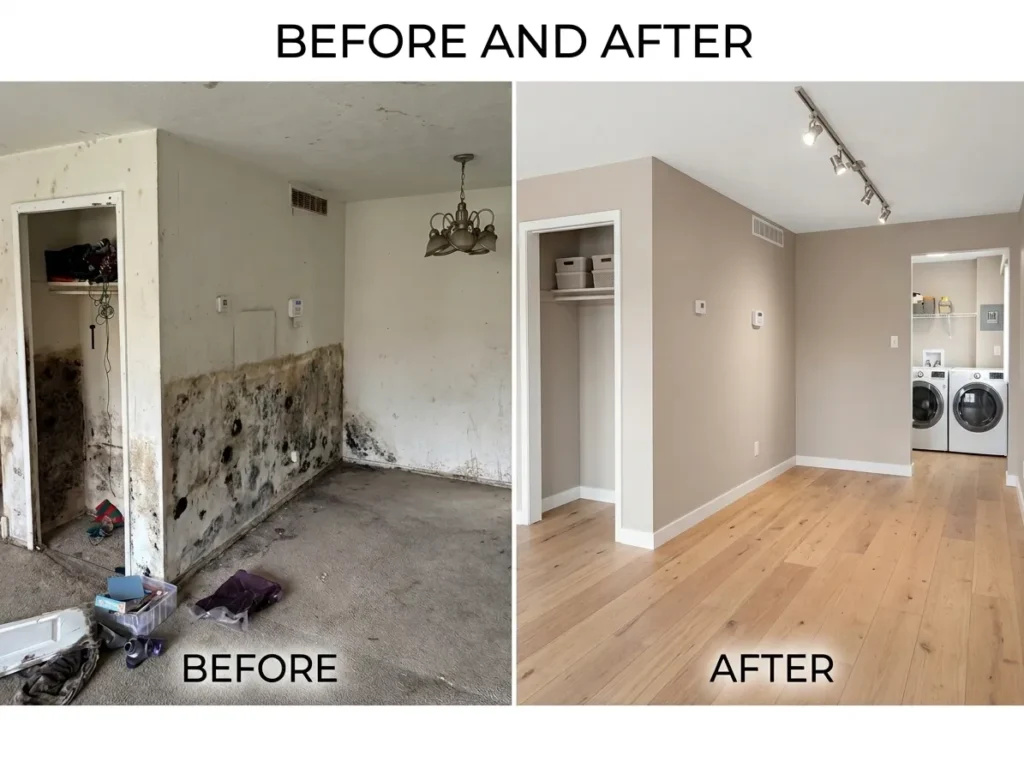
What Is Mold Remediation? A Clear Definition
Quick Answer: Mold remediation is the professional process of safely removing mold colonies from a structure, addressing the moisture source that caused the growth, and restoring indoor air quality to safe levels, distinct from simple mold “cleaning,” which does not address root causes or containment.
Mold remediation typically includes:
- Inspection and assessment of the affected area
- Moisture source identification and correction
- Containment to prevent spore spread during removal
- Physical removal of mold-affected materials
- HEPA air filtration and air scrubbing
- Antimicrobial treatment of remaining surfaces
- Post-remediation verification testing
Simply wiping visible mold with bleach does not qualify as remediation. Without addressing the underlying moisture and using proper containment, mold frequently returns, often worse than before.
Why Mold Remediation Near Me in Lawrenceville Is Such a Common Search
Gwinnett County’s Humid Subtropical Climate
Lawrenceville sits within Georgia’s humid subtropical climate zone, where relative humidity regularly supports mold growth whenever moisture is present, even without an active leak.
Frequent Crawl Spaces and Basements
Many Lawrenceville homes, especially those built from the 1980s through the early 2000s, include crawl spaces or partially finished basements, both prone to trapped moisture and poor ventilation.
Storm Frequency Across Metro Atlanta
Gwinnett County experiences regular severe thunderstorms, and the National Weather Service tracks frequent flash flood and heavy rain warnings for the region, each one a potential mold trigger if water isn’t addressed quickly.
Delayed Response to Minor Leaks
Small, slow leaks, under sinks, around window frames, or behind washing machines, are often the biggest driver of “mold remediation near me” searches, because they go unnoticed until mold is already visible.
Signs You Need Mold Remediation in Your Lawrenceville Home
- Visible mold spots on walls, ceilings, or baseboards (black, green, white, or gray)
- A persistent musty or earthy odor, especially in bathrooms, basements, or crawl spaces
- Unexplained allergy symptoms, sneezing, coughing, itchy eyes, that improve when away from home
- Peeling paint or bubbling wallpaper
- Warped or discolored drywall
- Condensation on windows or pipes
- A recent water damage event that wasn’t fully dried
If any of these sound familiar, it’s time to search beyond “mold remediation near me” and get a professional inspection scheduled.
How to Tell If It’s Mold or Just Mildew
| Characteristic | Mildew | Mold |
| Color | Usually white, gray, or light yellow | Black, green, blue, or dark brown |
| Texture | Powdery or flat | Fuzzy, slimy, or raised |
| Location | Often surface-level (bathroom tile, shower grout) | Can penetrate porous materials like drywall and wood |
| Removal | Often cleanable with household products | Typically requires professional remediation |
| Health risk | Generally lower | Can be significant, especially certain black mold species |
If you’re unsure which one you’re dealing with, a professional mold inspection is the safest way to confirm before you attempt any DIY cleaning.
The Mold Remediation Process: What to Expect from Air Drop Water Restoration
Step 1: Inspection and Assessment
Our technicians inspect the affected area, identify the mold type where visually possible, and search for the underlying moisture source, because remediation without fixing the cause is only a temporary solution.
Step 2: Containment Setup
Plastic sheeting and negative air pressure machines isolate the affected area, preventing mold spores from spreading to unaffected parts of your Lawrenceville home during removal.
Step 3: Air Filtration
HEPA-filtered air scrubbers run continuously throughout the remediation process, capturing airborne spores and improving indoor air quality.
Step 4: Removal of Affected Materials
Mold-damaged drywall, insulation, and other porous materials are safely removed and disposed of according to industry guidelines.
Step 5: Cleaning and Antimicrobial Treatment
Remaining surfaces are cleaned and treated with antimicrobial solutions to eliminate residual spores and inhibit regrowth.
Step 6: Moisture Source Correction
Whether it’s a plumbing leak, poor crawl space ventilation, or grading issues near the foundation, we address the root cause to prevent mold from returning.
Step 7: Post-Remediation Verification
A final inspection, sometimes including third-party clearance testing, confirms the area meets acceptable mold spore levels before the containment is removed.
Found Mold in Your Lawrenceville Home?
Don’t wait, mold spreads quickly in Georgia’s humidity, and every day of delay increases your exposure risk. Call Air Drop Water Restoration at +1 (678) 374-9247 for 24/7 mold remediation service throughout Lawrenceville and Gwinnett County.
Common Causes of Mold Growth in Lawrenceville Homes
- Unaddressed water damage from a previous leak or flood
- Poor crawl space ventilation trapping ground moisture
- Leaky plumbing behind walls or under fixtures
- High indoor humidity without adequate dehumidification
- Roof leaks allowing moisture into attic spaces
- Condensation buildup around poorly insulated windows or pipes
- Basement seepage through foundation walls during heavy rain
Understanding the cause is just as important as removing the visible mold, otherwise, “mold remediation near me” becomes a search you’ll be making again in a few months.
Health Considerations: Why Professional Mold Remediation Matters
According to the U.S. Environmental Protection Agency (EPA), exposure to damp and moldy environments can cause a variety of health effects, particularly for individuals with asthma, allergies, or compromised immune systems. Common symptoms associated with mold exposure include:
- Nasal congestion and sinus irritation
- Coughing and throat irritation
- Eye irritation
- Skin irritation
- Worsening asthma symptoms in sensitive individuals
The Centers for Disease Control and Prevention (CDC) also notes that some individuals are more sensitive to mold than others, and that prompt cleanup of water damage is one of the most effective ways to prevent mold-related health issues.
This is exactly why proper containment and PPE use during mold remediation matters, protecting both the technicians performing the work and the residents of the home throughout the process.
Checklist Before Hiring a Mold Remediation Company Near You
- Does the company offer a documented inspection before starting work?
- Do they use containment and negative air pressure during removal?
- Do they identify and address the moisture source, not just the visible mold?
- Do they use HEPA air filtration during the process?
- Do they provide before-and-after documentation for your records?
- Are technicians trained in IICRC mold remediation standards?
- Do they offer 24/7 emergency availability?
- Can they coordinate directly with your homeowners insurance if applicable?
Local Spotlight: Mold Remediation Needs Across Gwinnett County
Mold remediation near me in Lawrenceville searches often extend to nearby Gwinnett County communities with similar climate and housing conditions:
- Duluth & Suwanee: Higher concentration of finished basements requiring specialized mold remediation
- Snellville & Lilburn (surrounding Lawrenceville): Mix of older and newer homes with varying plumbing conditions
- Buford & Sugar Hill: Proximity to Lake Lanier watershed raises humidity-related mold risk
- Norcross: Older housing stock with higher rates of crawl space moisture issues
Wherever you’re located within our Gwinnett County service footprint, our local crews already understand the housing stock and climate conditions driving mold growth in your area.
Schedule a Mold Inspection Before It Spreads Further
Even if you’re not sure whether what you’re seeing is mold, a professional inspection can give you clarity, and peace of mind. Call Air Drop Water Restoration at +1 (678) 374-9247 to schedule a mold inspection in Lawrenceville today.
Expert Tips: Preventing Mold Regrowth After Remediation
- Run a dehumidifier in basements and crawl spaces to keep humidity below 50%
- Ensure bathroom and kitchen exhaust fans vent outside, not into the attic
- Fix plumbing leaks immediately, even small ones
- Improve crawl space ventilation or consider encapsulation
- Clean gutters regularly to prevent water intrusion near the foundation
- Monitor previously affected areas for several months after remediation
Expert Insight
“The mold remediation near me in Lawrenceville calls we get most often aren’t from dramatic floods, they’re from small, ignored leaks that had months to feed mold growth behind a wall or under a cabinet. If you can smell something musty and can’t find the source, that’s exactly when you need a professional inspection, not a can of bleach spray.” Air Drop Water Restoration Restoration Team
Read our Water Damage Restoration Services page to understand how addressing water damage quickly helps prevent mold from developing in the first place.
Insurance and Mold Remediation in Lawrenceville, Georgia
Mold remediation coverage under homeowners insurance in Georgia varies significantly depending on the cause:
- Often covered: Mold resulting directly from a sudden, covered water damage event (like a burst pipe), when addressed promptly
- Often excluded: Mold resulting from long-term neglect, poor maintenance, or chronic humidity issues
- Sometimes limited: Many policies cap mold remediation coverage at a specific dollar amount, even when the underlying cause is covered
Air Drop Water Restoration documents every stage of the remediation process with photos and reports, helping Lawrenceville homeowners present the strongest possible case to their insurance carrier.
Why Choose Air Drop Water Restoration for Mold Remediation Near Me in Lawrenceville
- 24/7 emergency availability throughout Lawrenceville and Gwinnett County
- IICRC-informed remediation standards with proper containment and air filtration
- Root-cause focused: we fix the moisture source, not just the visible mold
- Direct insurance coordination to support your claim
- Locally based crews who understand Gwinnett County’s climate and housing stock
Read our 24/7 Mold Remediation Service page and Emergency Water Extraction Service page for more on how our services work together to protect your home.
Serving Lawrenceville and All of Gwinnett County
Air Drop Water Restoration provides mold remediation throughout Lawrenceville, Duluth, Suwanee, and the surrounding Metro Atlanta area, including Stone Mountain, Atlanta, Sandy Springs, Marietta, Roswell, Alpharetta, Johns Creek, Dunwoody, Brookhaven, Decatur, Smyrna, Kennesaw, East Point, College Park, Union City, Douglasville, Mableton, Tucker, Lithonia, Conyers, Covington, Stockbridge, McDonough, Peachtree City, and Fayetteville. Call +1 (678) 374-9247 now for immediate assistance.
People Also Ask
How much does mold remediation cost near Lawrenceville, Georgia?
Cost depends on the extent of mold growth, the affected materials, and whether the moisture source requires additional repair. Air Drop Water Restoration provides a clear estimate after an on-site inspection.
Can I do mold remediation myself?
Small surface mold on non-porous materials can sometimes be cleaned with household products, but mold on porous materials like drywall, or any area larger than about 10 square feet, generally requires professional remediation per EPA guidance.
How long does mold remediation take in a typical Lawrenceville home?
Most residential mold remediation projects take 3 to 7 days, depending on the extent of growth, containment needs, and whether structural repairs are required afterward.
Is black mold in Lawrenceville homes dangerous?
Coverage typically applies when mold results directly from a sudden, covered water damage event and is addressed promptly. Mold from long-term neglect is usually excluded, and many policies cap mold coverage regardless of cause.
Frequently Asked Questions About Mold Remediation Near Me in Lawrenceville
How do I know if I need mold remediation or just mold cleaning?
If mold covers a small, non-porous surface, cleaning may suffice. If it appears on drywall, wood, insulation, or covers an area larger than roughly 10 square feet, professional remediation is recommended to address both the growth and its source.
Can mold come back after remediation if the moisture issue isn’t fixed?
Yes, and often quickly. This is why proper mold remediation always includes identifying and correcting the underlying moisture source, not just removing visible growth.
Is a musty smell without visible mold still worth investigating?
Yes. A persistent musty odor often indicates hidden mold growth behind walls, under flooring, or in a crawl space, even without visible surface signs.
What’s the difference between mold testing and mold remediation?
Mold testing identifies the presence, type, and concentration of mold spores, while remediation is the actual removal and correction process. Testing can be done before remediation to confirm the issue, or after to verify successful cleanup.
Are certain rooms in a Lawrenceville home more prone to mold?
Yes. Bathrooms, basements, crawl spaces, attics, and areas around windows or plumbing fixtures tend to have higher humidity and are more susceptible to mold growth.
Do I need to leave my home during mold remediation?
Depending on the extent of the affected area and containment setup, some homeowners choose to stay elsewhere temporarily, particularly for larger remediation projects. Your technician will advise based on your specific situation.
How can I prevent mold in my Lawrenceville crawl space long-term?
Improving ventilation, addressing grading issues, and considering crawl space encapsulation are among the most effective long-term prevention strategies for Gwinnett County’s humid climate.
Does Air Drop Water Restoration provide mold remediation for rental properties in Lawrenceville?
Yes, we work with both homeowners and landlords throughout Lawrenceville and Gwinnett County to address mold issues in owner-occupied and rental properties.
What certifications should I look for in a mold remediation company?
Look for technicians trained to IICRC mold remediation standards, which establish industry best practices for containment, removal, and verification. Learn more through the IICRC.
Can mold remediation improve my home’s indoor air quality?
Yes. Removing mold colonies and improving humidity control significantly reduces airborne spore counts, which can improve indoor air quality and reduce allergy-related symptoms for sensitive household members.
Is it normal to still smell a faint odor immediately after mold remediation?
A faint odor can linger briefly as antimicrobial treatments finish working, but a persistent or worsening musty smell after remediation should be reinspected.
How often should Lawrenceville homeowners have their crawl space checked for mold?
An annual inspection is a reasonable baseline, with more frequent checks recommended for homes with a history of moisture issues or those without proper crawl space ventilation.
Does Air Drop Water Restoration offer emergency mold remediation on weekends in Lawrenceville?
Yes, our team is available 24 hours a day, 7 days a week, including weekends and holidays, for mold remediation needs throughout Lawrenceville and Gwinnett County.
Conclusion: Trusted Mold Remediation Near Me in Lawrenceville
Mold remediation near me in Lawrenceville isn’t just about removing what you can see, it’s about identifying the moisture source, containing the spread, and restoring your home to a safe, healthy condition from the inside out.
Air Drop Water Restoration has built our reputation throughout Lawrenceville and Gwinnett County on exactly that standard: thorough inspection, proper containment, IICRC-informed removal methods, and a focus on preventing mold from ever coming back.
Noticing mold or a musty smell in your Lawrenceville home? Don’t wait for it to spread further. Call Air Drop Water Restoration at +1 (678) 374-9247 for 24/7 mold remediation service throughout Lawrenceville and the greater Gwinnett County area.