 Skip to content
Home mold removal Atlanta GA homeowners need is rarely about the patch you can see. It is about the moisture problem you cannot.
You smell something musty. You spot a dark stain on the ceiling. Maybe your allergies flared for no clear reason. Now you are searching for answers.
This guide gives them. You will learn how mold grows in Georgia homes, how to tell a small problem from a serious one, how professionals test and remove mold, and how to keep it from coming back. The advice comes from restoration work, not marketing.
Air Drop Water Restoration is based in Stone Mountain, GA and has served Metro Atlanta since 2012. We are IICRC-certified, licensed and insured. Think you have mold? Call +1 (678)-374-9247.
Seeing or smelling mold? Get a professional inspection. Call Air Drop Water Restoration at +1 (678)-374-9247 and we will assess the source, the scope and the safest removal plan.
What Is Home Mold Removal Atlanta GA? A Clear Definition
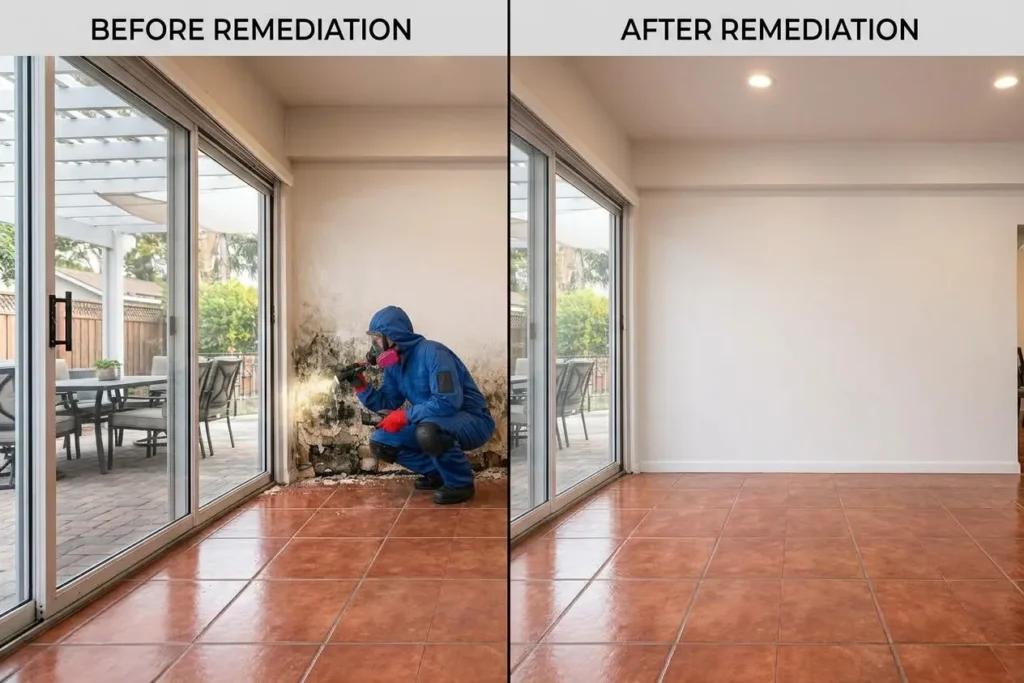
Home mold removal Atlanta GA is the professional process of finding mold, containing it, removing contaminated materials, cleaning affected areas and correcting the moisture source so it does not return. The industry term is mold remediation.
It is not just wiping or spraying. It is controlled removal.
What Is Mold?
Mold is a type of fungus. It lives outdoors and indoors. Spores float in the air and settle on surfaces. When spores land on a damp, organic surface, they grow.
What Mold Needs to Grow
- Moisture (the one you can control)
- A food source: drywall paper, wood, dust, fabric, insulation
- Moderate temperature
- Time: often 24 to 48 hours
The EPA is clear on the key point. Mold control is moisture control. There is no practical way to eliminate every mold spore indoors.
Why Home Mold Removal Atlanta GA Is So Common
Atlanta is mold country. Several local factors work together.
Georgia Conditions That Fuel Mold
- High humidity through much of the year
- Heavy rainfall: roughly 50 inches annually, according to the National Weather Service Peachtree City office
- Warm temperatures that speed growth
- Red clay soil that holds water against foundations
- Basements and crawl spaces common in DeKalb, Fulton and Gwinnett homes
- Older homes with aging plumbing and roofs
- Tight newer construction that traps moist air
- HVAC condensation issues in hot summers
Common Mold Sources Inside Atlanta Homes
| Location | Typical Moisture Source |
| Bathrooms | Poor ventilation, leaking tub or shower |
| Kitchens | Under-sink leaks, dishwasher or fridge lines |
| Basements | Groundwater seepage, sump failure, high humidity |
| Crawl spaces | Ground moisture, failed vapor barrier |
| Attics | Roof leaks, poor ventilation, bath fan venting |
| Windows | Condensation, failed seals |
| HVAC areas | Condensate drain clogs, duct sweating |
| Laundry rooms | Washing machine hose leaks, dryer vent issues |
| Walls | Hidden plumbing leaks |
Signs You Need Home Mold Removal Atlanta GA
Mold does not always look dramatic. Learn the signals.
Visual Signs
- Black, green, gray, white or orange spots
- Fuzzy or powdery patches
- Water stains or rings on ceilings and walls
- Peeling, bubbling or cracking paint
- Warped or discolored baseboards
- Visible condensation on windows and pipes
Smell Signs
- Musty or earthy odor
- Stale smell that returns after cleaning
- Odor that gets stronger when the HVAC runs
Health Signs
The CDC notes that mold exposure can trigger nasal stuffiness, throat irritation, coughing, wheezing and eye or skin irritation in some people. People with asthma, allergies or weakened immune systems can react more strongly.
Symptoms that improve when you leave home are a clue.
Event Signs
- Past flooding or roof leak
- Burst pipe or appliance failure
- Water damage that was not dried
- Long periods of high indoor humidity
Quick Answer: How Do I Know If I Have Mold in My House?
Look for visible growth, musty odor, water stains, peeling paint and a history of water damage. If you smell mold but see nothing, moisture may be hiding inside walls, floors or attic spaces. A professional moisture inspection can confirm it.
Types of Molds Found in Atlanta Homes
You do not need to identify the species to know it needs attention. Still, it helps to understand the common ones.
| Mold Type | Appearance | Typical Location |
| Cladosporium | Olive-green to black, powdery | Fabrics, wood, cool surfaces |
| Penicillium | Blue-green, fuzzy | Water-damaged materials, insulation |
| Aspergillus | Yellow, green or gray, layered | Dust, HVAC, walls |
| Alternaria | Dark, velvety | Showers, sinks, window frames |
| Stachybotrys (often called black mold) | Dark black-green, slimy | Chronically wet drywall and paper |
The Truth About Black Mold
“Black mold” gets attention. Color alone does not tell you the species or the risk. Any mold growing indoors should be treated seriously and removed properly.
When Can You Handle Mold Yourself?
Some small problems are manageable. Others are not.
DIY May Be Reasonable If
- The area is small. The EPA suggests that areas under about 10 square feet may be manageable by homeowners.
- The cause is a known, fixed surface moisture problem.
- The material is hard and non-porous, like tile.
- No one in the home has respiratory conditions.
- There is no sewage or contaminated water involved.
Call a Professional If
- The mold covers more than 10 square feet
- It keeps coming back
- You smell mold but cannot find it
- It came from flooding, sewage or contaminated water
- It is in the HVAC system
- It affects porous materials such as drywall, insulation or carpet
- Someone in the home has asthma, allergies or a weakened immune system
- You are making an insurance claim
What Not to Do
- Do not dry-scrub or sand mold. This releases spores.
- Do not run the HVAC if mold is in the system or nearby.
- Do not paint over mold.
- Do not rely on bleach alone. The EPA does not recommend routine bleach use for mold cleanup, and bleach does not fix porous materials or the moisture source.
Do not disturb large growth without containment.
The Professional Home Mold Removal Atlanta GA Process, Step by Step
Here is how Air Drop handles mold remediation. It follows industry practices informed by the IICRC S520 standard for professional mold remediation. See IICRC for more.
Step 1: Inspection and Moisture Assessment
Technicians inspect the property with moisture meters and thermal imaging. We look for visible mold, hidden moisture and the source.
Step 2: Mold Testing (When Appropriate)
Testing can include air sampling and surface sampling. Testing helps document conditions, identify hidden growth and confirm cleanup success. EPA notes testing is not always necessary, but it can be useful in certain situations such as documentation or when mold is suspected but not visible.
Step 3: Source Correction
Mold returns if moisture remains. We locate and address leaks, high humidity and ventilation issues. If plumbing repair is needed, our emergency plumber service can help.
Step 4: Containment
We isolate the work area with plastic barriers and negative air pressure. This prevents spores from spreading to clean rooms.
Step 5: Air Filtration
HEPA air scrubbers filter airborne spores during work.
Step 6: Removal of Contaminated Materials
Porous materials with mold growth, like drywall, insulation and carpet, are carefully removed and bagged. Structural wood can often be cleaned.
Step 7: Cleaning and HEPA Vacuuming
We HEPA vacuum and damp wipe surfaces. Wood framing may be wire brushed or sanded under containment.
Step 8: Antimicrobial Treatment and Drying
We apply appropriate treatments and dry the structure completely. Structural drying is key to prevent recurrence. See our water damage mitigation page.
Step 9: Verification
Post-remediation checks confirm moisture readings are normal and the area is clean. Clearance testing can be performed where needed.
Step 10: Reconstruction
We replace drywall, insulation, paint and finishes. One team handles the repair so there are no gaps.
Get the safest removal plan. Air Drop provides inspection, testing, containment and removal under one roof. Call +1 (678)-374-9247 for a free on-site assessment.
Home Mold Removal Atlanta GA vs. Mold Cleaning: What Is the Difference?
This is where many homeowners get misled.
| Factor | Surface Cleaning | Professional Mold Remediation |
| Method | Spray and wipe | Containment, HEPA, material removal |
| Moisture source | Usually ignored | Identified and corrected |
| Hidden growth | Missed | Investigated with meters and imaging |
| Spore control | None | Negative air, HEPA filtration |
| Porous materials | Left in place | Removed and replaced |
| Verification | Visual only | Moisture readings and optional testing |
| Recurrence risk | High | Low when moisture is fixed |
| Warranty | Rare | One year warranty on our services |
Why Spraying and Painting Fails
Cover-up products hide stains. They do not remove growth or fix moisture. Mold resurfaces, often worse.
The Link Between Water Damage and Home Mold Removal Atlanta GA
Most mold in Georgia homes starts with water. A leak, a flood, a failed appliance or unchecked humidity.
Mold Timeline After Water Damage
| Time | What Happens |
| 0 to 24 hours | Best window to dry and prevent mold |
| 24 to 48 hours | Mold can begin to grow, according to the EPA |
| 48 to 72 hours | Colonies spread on drywall, insulation and wood |
| 1 week or more | Visible growth, odor, material damage |
Why Mitigation Matters
Professional extraction and structural drying remove the moisture mold needs. Surface drying alone leaves moisture inside walls and subfloors. Our guide on water mitigation vs. remediation explains the difference in depth.
Common Scenarios We See
- Slow leak behind a bathroom wall
- Dishwasher line that dripped for months
- Roof leak above an attic bedroom
- Basement seepage after storms
- AC condensate line clogged and overflowing
- Past flood damage that was only dried on the surface
Mold in Specific Areas: Home Mold Removal Atlanta GA by Room
Each space has its own challenge.
Mold in Basements
Basements combine humidity, cool surfaces and groundwater risk. Mold often grows on stored boxes, carpet, drywall and framing. See our guide on water in basement near Stone Mountain.
Mold in Attics
Roof leaks and poor ventilation create condensation. Mold appears on roof decking and insulation.
Mold in Bathrooms
Inadequate exhaust fans and shower leaks fuel growth. Check behind tiles and under vanities.
Mold in Crawl Spaces
Ground moisture rises into the structure. Encapsulation and vapor barriers help.
Mold in HVAC Systems
Condensation inside ducts and air handlers can spread spores through your home. Do not run a system you suspect is contaminated.
Mold on Walls and Ceilings
Often there is a signal of a leak above or inside the wall. The stain is usually the tip of the issue.
Mold After Fire and Water Damage
Firefighting water leaves structures wet. Without proper drying, mold follows. See our fire damage restoration service.
Home Mold Removal Atlanta GA: Cost Factors
Every job is different. Instead of guessing a number, understand what drives the price.
| Factor | Why It Matters |
| Size of affected area | More square footage means more labor and materials |
| Location | Attics and crawl spaces require extra access effort |
| Type of materials | Porous materials usually require removal |
| Moisture source | Plumbing or structural repairs add scope |
| Containment needs | Larger jobs need more barriers and filtration |
| Testing | Air and surface samples add lab costs |
| Reconstruction | Replacing drywall, flooring and paint |
| Response time | Early action reduces damage |
How to Keep Costs Down
- Act quickly. Small problems cost less.
- Fix leaks immediately.
- Dry water damage within 24 to 48 hours.
- Ask for a written scope of work.
- Ask for moisture documentation.
Air Drop provides free on-site assessments, so you understand the scope before work begins.
Insurance and Home Mold Removal Atlanta GA
Mold coverage varies widely. Read your policy.
What Often Matters
- Whether the mold resulted from a covered water event
- Policy limits on mold remediation
- Whether you acted promptly to mitigate
- Whether the cause was long-term neglect or a sudden loss
Tips for Your Claim
- Report water damage immediately.
- Document the damage with photos and video.
- Keep moisture logs and dry records.
- Save invoices and test reports.
- Communicate in writing.
Consumers can find help from the Georgia Office of Insurance and Safety Fire Commissioner. Flood-related losses may require separate coverage through the National Flood Insurance Program.
Protect your family and your claim, Call Air Drop Water Restoration at +1 (678)-374-9247 for documented inspections and removal you can trust.
Expert Tips: Prevent Mold in Your Atlanta Home
Prevention is simple and cheap compared to remediation.
Humidity Control
- Keep indoor humidity between 30 and 60 percent, as the EPA recommends. Lower is better in summer.
- Run a dehumidifier in basements.
- Use exhaust fans in bathrooms and kitchens.
- Vent dryers outside.
- Use your AC. It dehumidifies.
Leak Prevention
- Fix leaks within 24 to 48 hours.
- Inspect under sinks twice a year.
- Replace aging washing machine hoses.
- Check the water heater for corrosion.
- Clean and inspect roof and gutters before storm season.
- Clear AC condensate drains.
Housekeeping Habits
- Wipe up spills immediately.
- Dry shower walls after use.
- Store items off basement floors.
- Use plastic storage bins.
- Do not leave wet laundry sitting.
- Let air circulate behind furniture.
Contractor Advice From the Field
The biggest mistake we see is treating mold as a cleaning problem. It is a moisture problem.
If you scrub it and it comes back, there is water somewhere. Find it. Fix it. Then remove the mold.
Featured Snippet: Home Mold Removal Atlanta GA Checklist
- Stop the water source first
- Photograph and document the mold
- Do not disturb or dry-scrub it
- Turn off the HVAC if mold is near the system
- Keep children, pets and sensitive people away
- Call a certified mold remediation company
- Request testing and moisture assessment
- Ask for a written containment and removal plan
- Dry the structure completely
- Verify and rebuild.
Why Atlanta Homeowners Choose Air Drop for Home Mold Removal
We are Stone Mountain based. We know Georgia homes and Georgia humidity.
- IICRC-certified technicians
- 24/7 emergency response
- Licensed and insured
- Mold testing, removal and prevention
- Water mitigation and structural drying in-house
- Plumbing support to fix the source
- Reconstruction under one plan
- Direct service without intermediaries
- One year warranty on our services
- Serving Metro Atlanta since 2012
Areas We Serve
Stone Mountain, Atlanta, Tucker, Decatur, Lithonia, Conyers, Covington, Norcross, Duluth, Lawrenceville, Suwanee, Dunwoody, Brookhaven, Sandy Springs, Roswell, Alpharetta, Johns Creek, Marietta, Smyrna, Kennesaw, East Point, College Park, Union City, Mableton, Douglasville, Stockbridge, McDonough, Peachtree City, Fayetteville and Newnan. View our full-service area.
Related Services
- Mold Remediation, Testing and Removal
- Water Damage Restoration
- Emergency Water Extraction
- Sewage Damage Cleanup
- Fire and Smoke Damage Restoration
- Emergency Plumber
External Link Opportunity: Link to the Georgia Environmental Protection Division (EPD) and to the EPA’s indoor air quality pages for homeowner resources.
Mold Testing for Home Mold Removal Atlanta GA: What the Options Mean
Testing can feel confusing. Here is what each type does.
| Test Type | What It Measures | When It Helps |
| Air sampling | Spore concentrations in indoor air compared to outdoor air | Suspected hidden mold, documentation, clearance |
| Surface sampling | Mold on a specific surface | Confirming growth on a visible stain |
| Bulk sampling | A piece of material | Checking a specific building material |
| Moisture mapping | Moisture levels in walls and floors | Finding the cause and hidden wet areas |
| Thermal imaging | Temperature differences that suggest moisture | Locating leaks and wet insulation |
What Testing Cannot Do
Testing cannot tell you exactly how sick a particular mold will make you. It also cannot replace fixing the moisture source. Results are a snapshot, not a guarantee.
Why Moisture Mapping Matters Most
Finding moisture is often more valuable than naming species. If a wall reads wet, mold is a risk, whatever the lab says.
Health Considerations Behind Home Mold Removal Atlanta GA
Mold affects people differently. Some notice nothing. Others react strongly.
Who Is Most Sensitive
- Infants and young children
- Older adults
- People with asthma or other lung conditions
- People with allergies
- People with weakened immune systems
Why Fast Action Helps
Reducing moisture and removing contaminated materials lowers the number of airborne spores. The EPA and CDC both emphasize moisture control and prompt cleanup.
If someone in your home has serious or persistent symptoms, talk with a medical professional. We provide restoration services, not medical advice.
Home Mold Removal Atlanta GA for Renters, Landlords and HOA Communities
Mold responsibility depends on your situation.
If You Rent
- Report mold or leaks to your landlord in writing right away.
- Keep photos and copies of every message.
- Do not attempt large cleanups yourself.
- Review your lease and local tenant protections.
- Contact your renter’s insurer about belongings.
If You Are a landlord
- Respond quickly to moisture complaints.
- Fix leaks first, then remove mold properly.
- Keep records of inspections and repairs.
- Use certified professionals for larger problems.
If You Live in a Condo or HOA
- Report water intrusion to management immediately.
- Ask about the master policy and who handles which repairs.
- Document leaks that come from a neighboring unit.
Air Drop works with property managers, landlords and homeowners across Metro Atlanta. Our documentation helps everyone understand what happened and what was done.
Common Myths About Home Mold Removal Atlanta GA
| Myth | Reality |
| “Bleach kills all mold.” | Bleach does not solve porous materials or moisture. The EPA does not recommend routine bleach use. |
| “Only black mold is dangerous.” | Any indoor mold growth deserves attention. |
| “If I cannot see it, there is no mold.” | Mold often grows behind walls and under floors. |
| “Painting over it fixes it.” | Mold continues to grow underneath. |
| “A dehumidifier alone removes mold.” | It controls humidity but does not remove existing growth. |
| “Mold is just a cosmetic issue.” | It can damage materials and affect air quality and comfort. |
| “Once removed, it never returns.” | Without moisture control, it will. |
Questions to Ask Before Hiring a Home Mold Removal Atlanta GA Company
- Are you IICRC-certified?
- Are you licensed and insured in Georgia?
- Will you identify and correct the moisture source?
- Do you use containment and HEPA air filtration?
- How do you handle porous materials?
- How will you verify the work is complete?
- Will you provide a written scope and documentation?
- Do you offer reconstruction?
- Is the testing company independent from the removal company?
- What warranty do you provide?
Red Flags
- Offers to spray and walk away
- No containment plan
- Pressure to sign immediately
- Vague pricing with no scope
- No mention of moisture
What to Expect on the Day of Home Mold Removal Atlanta GA
Knowing the routine reduces stress.
Before the Crew Arrives
- Remove valuables and pets from the work area.
- Clear a path for equipment.
- Plan to stay out of the affected zone while work is underway.
During Work
- Technicians in protective gear set up containment and negative air.
- Equipment such as HEPA scrubbers will run continuously. Expect some noise.
- Affected materials are removed, bagged and carried out in a controlled way.
- Surfaces are HEPA vacuumed and cleaned.
After Work
- Moisture readings are taken and recorded.
- The area is inspected and, when appropriate, tested.
- Reconstruction is scheduled.
- You receive documentation for your records and insurance.
How Long Should You Stay Out?
It depends on the scope. For small, contained jobs, many households remain at home and avoid only the work area. For larger jobs or HVAC involvement, temporary relocation may be wise. We will advise you before work begins.
Frequently Asked Questions About Home Mold Removal Atlanta GA
How much does home mold removal Atlanta GA cost?
It depends on the area size, location, materials, containment needs, testing and any repairs needed. Early action keeps costs lower. Air Drop offers free on-site assessments, so you know the scope before work begins.
Is home mold removal Atlanta GA dangerous to do myself?
Small, surface-level patches may be manageable with proper protection. Large or hidden growth can release spores into your home and should be handled by professionals using containment and HEPA filtration.
How long does home mold removal Atlanta GA take?
Small jobs may take a day or two. Larger remediation, including drying and reconstruction, can take a week or more. Timelines depend on size, materials and moisture source.
Can mold come back after home mold removal?
Yes, if the moisture source is not fixed. Professional remediation includes correcting the cause and drying the structure completely.
Does homeowners insurance cover home mold removal Atlanta GA?
Often when the mold results from a covered sudden water loss. Many policies limit mold coverage. Review your policy and speak with your adjuster.
Should I test mold before removal?
Testing can help confirm hidden mold, document conditions and verify cleanup. The EPA says it is not always necessary when growth is visible. A professional can advise based on your situation.
Does bleach kill mold?
Bleach can lighten surface stains on non-porous materials but does not penetrate porous materials or fix moisture. The EPA does not recommend routine bleach use for mold cleanup.
How do I know if mold is making me sick?
Symptoms like congestion, coughing, wheezing and irritation that improve when you leave the home can be a clue. See a medical professional for health concerns. The CDC offers information on mold and health.
What causes mold in Atlanta homes?
Moisture. Common sources include leaks, flooding, high humidity, poor ventilation, roof damage and unaddressed water damage
Who do I call for home mold removal Atlanta GA?
Call a certified mold remediation company. Air Drop Water Restoration serves Metro Atlanta from Stone Mountain, 24/7, at +1 (678)-374-9247.
Conclusion: Take Control of Home Mold Removal Atlanta GA Today
Home mold removal Atlanta GA homeowners need is more than cleaning. It is finding the moisture, containing the growth, removing contaminated materials and rebuilding properly.
Georgia’s humidity gives mold an advantage. That makes early action and expert help even more important. The sooner you act, the smaller the problem and the lower the cost.
Air Drop Water Restoration brings IICRC-certified expertise, 24/7 response and a complete plan from inspection to reconstruction. We have protected Metro Atlanta homes since 2012.Need home mold removal Atlanta GA? Call now.
Do not let mold spread. Call Air Drop Water Restoration at +1 (678)-374-9247 for 24/7 emergency response, free on-site assessments and a one year warranty on our services. Serving Stone Mountain, Atlanta and all of Metro Atlanta. Visit [airdropatlanta.com