 Skip to content

Water mitigation vs remediation sounds like contractor jargon. It is not. It is the difference between a home that is truly dry and a home that looks dry while mold grows inside the walls.
Here is the common story. A pipe leaks. You mop up. You run fans for a weekend. The floor feels dry. You move on.
Three weeks later you smell something musty. Baseboards are stained. Paint is bubbling. That is what surface drying leaves behind.
This Article explains water mitigation vs remediation in plain language. You will learn what each phase does, when each is needed, how professional drying actually works and what to ask your contractor. Air Drop Water Restoration has served Metro Atlanta from Stone Mountain since 2012. If water is in your home now, call +1 (678)-374-9247.
tel:678-374-9247Not sure if your home is truly dry? Book a moisture inspection with Air Drop Water Restoration at +1 (678)-374-9247. We use meters and thermal imaging, not guesswork.
Water Mitigation vs. Remediation: The Short Answer
Water mitigation vs remediation comes down to timing and purpose.
Water mitigation is the immediate emergency response that stops further damage. It includes stopping the source, extracting standing water, removing wet materials and starting structural drying.
Water remediation is the process of removing contaminants and correcting the damage. It includes cleaning, disinfecting, mold removal and rebuilding. In some regions the term is used loosely and overlaps with restoration.
Quick Comparison
| Factor | Water Mitigation | Water Remediation |
| Goal | Stop damage from spreading | Remove contamination and repair damage |
| Timing | Immediately, first 24 to 72 hours | After mitigation, sometimes overlapping |
| Typical work | Extraction, drying, dehumidification, board-up | Disinfection, mold removal, demolition, rebuild |
| Equipment | Extractors, air movers, dehumidifiers | HEPA scrubbers, containment, antimicrobials |
| Insurance priority | Reasonable steps to prevent more loss | Repairs and scope approved by adjuster |
| Risk of delay | Mold, structural failure, higher cost | Persistent contamination, health risk |
The Easy Way to Remember
Mitigation is the tourniquet. Remediation is the surgery and recovery.
What Is Water Mitigation? A Clear Definition
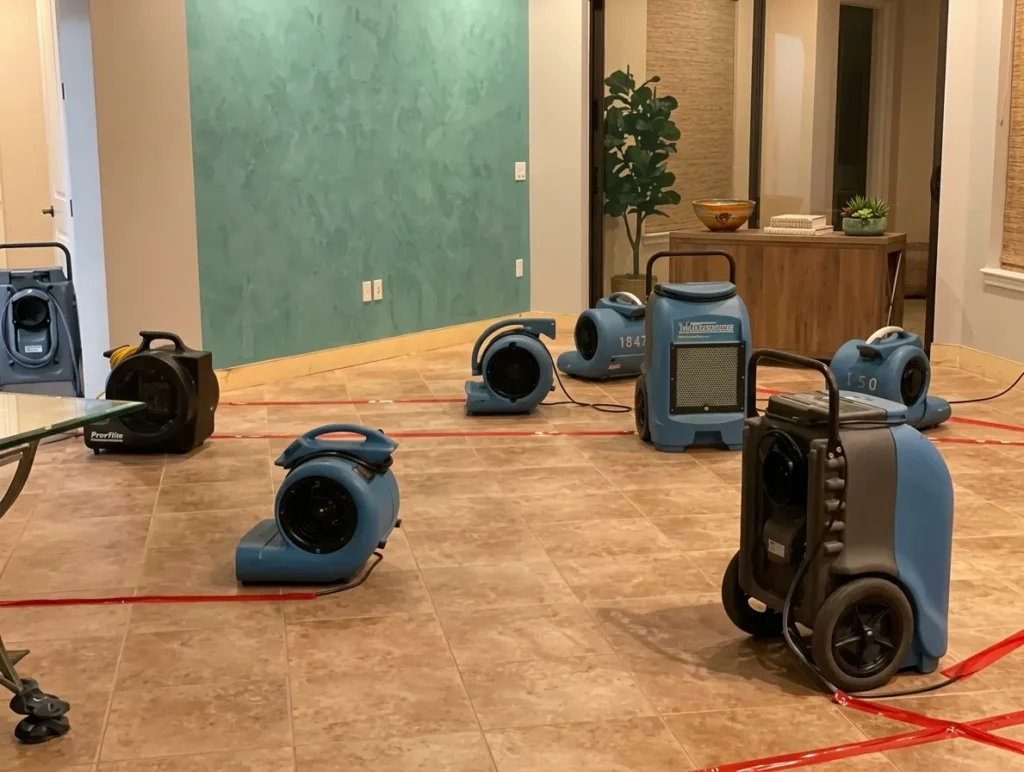
Water mitigation is the set of actions taken immediately after a water loss to prevent additional damage to the structure and contents. It is time-sensitive and technical.
Core Water Mitigation Services
- Stopping or isolating the water source
- Emergency water extraction
- Moisture mapping and detection
- Removing saturated materials like carpet pad and wet insulation
- Setting air movers and dehumidifiers
- Applying antimicrobial treatments
- Documenting readings for insurance
Why Mitigation Is Urgent
Wet building materials begin to degrade fast. The EPA recommends drying wet materials within 24 to 48 hours to prevent mold growth, as outlined in its mold cleanup guidance.
Every hour matters. Water wicks upward in drywall. Hardwood starts to cup. Metal begins to corrode.
Mitigation Is Not Just “Drying”
Professional mitigation is a science. It follows industry standards such as the IICRC S500 for professional water damage restoration. It uses measurements, not feelings.
Learn more about our approach on the water damage mitigation page.
What Is Water Remediation? A Clear Definition
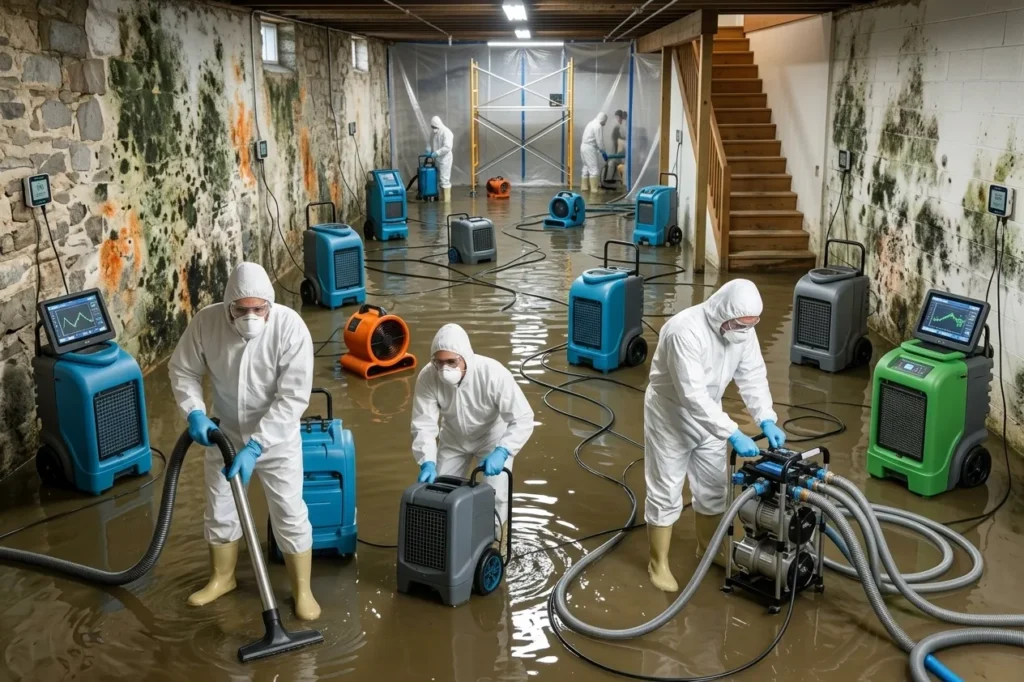
Water remediation is the process of correcting damage and removing contamination after water has intruded into a property. It often follows mitigation.
Core Water Remediation Services
- Cleaning and disinfecting affected surfaces
- Removing contaminated materials (Category 2 or 3 water)
- Mold testing and mold removal
- HEPA air filtration
- Odor control
- Sewage and biohazard cleanup
- Reconstruction and repairs
When Remediation Becomes Necessary
Remediation is typically needed when:
- Water is contaminated (gray or black water)
- Mold is present or suspected
- Materials cannot be dried and must be removed
- Sewage or biohazards are involved
- Water has been present more than 48 to 72 hours
Remediation and Mold
Mold remediation is a specific form of remediation. The EPA notes that moisture control is the key to mold control, and that large mold problems can require professional help. See the EPA mold resources. Our mold remediation service includes testing, containment and removal.
Water Mitigation vs Remediation vs. Restoration: Clearing the Confusion
Three words get mixed up. Here is how they differ.
| Term | Meaning | Example |
| Mitigation | Stop further damage | Extract water, dry structure |
| Remediation | Remove contamination or hazards | Clean sewage, remove mold |
| Restoration | Return the property to pre-loss condition | Replace drywall, paint, flooring |
The Typical Sequence
- Mitigation begins immediately.
- Remediation addresses contamination or mold where needed.
- Restoration rebuilds and repairs.
Many companies, including Air Drop Water Restoration, handle all three phases. This reduces handoffs and delays. See our full water damage restoration service.
Why Surface Drying Isn’t Enough: The Core of Water Mitigation vs Remediation
This is the heart of the issue. Water mitigation vs remediation fails when people treat visible dryness as the finish line.
What Surface Drying Looks Like
- Mopping and towel-drying floors
- Running box fans and household dehumidifiers
- Opening windows
- Waiting for things to “air out”
- Vacuuming wet carpet with a shop vac
What Surface Drying Misses
Water does not stay where you see it. It travels.
- Wall cavities: water wicks up drywall and soaks insulation behind it.
- Subfloors: plywood and OSB hold water long after the surface feels dry.
- Under cabinets: toe-kicks trap moisture against framing.
- Carpet pad: foam holds water like a sponge.
- Ceilings: wet insulation sits above a ceiling that “looks fine.”
- Concrete slabs: moisture vapor rises for days or weeks.
The Science: Hygroscopic Materials
Wood, drywall and many building materials are hygroscopic. They absorb and release moisture based on surrounding humidity. A surface can dry while the core stays wet.
That is why professionals measure moisture content, not just surface feel.
Drying Goals Are Measurable
Professionals compare moisture readings in affected materials to readings in a dry reference area. The goal is to reach the “dry standard” for that structure. Drying is complete only when documented readings confirm it.
The Humidity Problem in Georgia
Atlanta summers are humid. Higher ambient humidity slows evaporation. Box fans simply push moist air around.
Professional dehumidifiers remove moisture from the air and keep drying conditions controlled. That is why equipment must be calibrated to local temperature and humidity.
Water Mitigation vs Remediation: What Happens When You Skip Steps
Skipping steps feels cheaper. It rarely is.
Skipping Mitigation
If you delay extraction and drying:
- Water spreads to more rooms
- Drywall and flooring fail
- Mold growth can begin within 24 to 48 hours
- Costs rise sharply
- Insurance may question avoidable damage
Skipping Remediation
If you leave contamination or mold behind:
- Odors persist
- Mold returns
- Air quality drops
- Health problems may follow, especially for children, older adults and anyone with asthma or allergies
- Resale value suffers
The CDC notes that mold exposure can cause respiratory irritation and allergic reactions in some people.
The Hidden Cost of Surface Drying
| Problem | What Happens | Eventual Result |
| Wet insulation | Holds moisture for weeks | Mold, odor, wood rot |
| Wet subfloor | Swells and warps | Buckled flooring |
| Wet drywall | Wicks upward | Stains, bubbling paint, mold |
| Trapped moisture | Feeds microbial growth | Costly remediation |
Water Mitigation vs Remediation: How the Process Works Step by Step
Here is how Air Drop handles a typical loss from start to finish.
Phase 1: Emergency Response and Assessment
You call. A crew is dispatched. We assess the source, extent and water category.
Phase 2: Water Extraction
We remove standing water with truck-mounted and portable extractors. Mechanical removal is far faster than evaporation.
Phase 3: Moisture Mapping
We use moisture meters, thermal cameras and hygrometers to map every wet area, including hidden ones.
Phase 4: Selective Demolition
Materials that cannot be dried are removed. This may include carpet pad, wet insulation, baseboards and damaged drywall.
Phase 5: Structural Drying
We place air movers and dehumidifiers according to the affected cubic footage and water class. We may create drying access in wall cavities.
Phase 6: Daily Monitoring
Technicians check readings daily and adjust equipment. Drying ends only when materials meet drying goals.
Phase 7: Cleaning and Antimicrobial Treatment
We clean and sanitize affected surfaces. This is where mitigation begins to overlap with remediation.
Phase 8: Mold Testing and Remediation (If Needed)
If mold is found, we set containment, filter the air with HEPA units and remove contaminated materials according to industry protocols.
Phase 9: Restoration and Reconstruction
We rebuild: drywall, insulation, paint, flooring, trim and cabinetry. One team keeps the project organized.
Get both phases handled by one team. Air Drop delivers mitigation, remediation and reconstruction. Call +1 (678)-374-9247 for a free on-site assessment.
Water Damage Categories and Classes in Water Mitigation vs. Remediation
The IICRC classifies water damage so crews know what equipment and safety measures to use. You can read more at IICRC.org.
Categories of Water
| Category | Description | Common Source | Typical Approach |
| Category 1 | Clean water | Broken supply line | Mitigation and drying |
| Category 2 | Gray water | Dishwasher, washing machine overflow | Mitigation, cleaning, possible material removal |
| Category 3 | Black water | Sewage, flood, standing water | Remediation, removal of porous materials, disinfection |
Classes of Water Damage
| Class | Extent | Drying Demand |
| Class 1 | Small area, low-porosity materials | Low |
| Class 2 | Entire room, wet carpet and walls | Moderate |
| Class 3 | Water from overhead, saturated walls and ceilings | High |
| Class 4 | Deep saturation in low-permeance materials like hardwood, plaster, concrete | Specialty drying |
Why This Matters
A Category 3 loss moves beyond mitigation into remediation immediately. Porous materials exposed to black water, like carpet and drywall, usually must be removed and disposed of.
Featured Snippet: Water Mitigation vs Remediation Checklist
Use this checklist to know which phase you are in.
You need mitigation if:
- Water is standing or actively leaking
- Carpet, drywall or flooring is wet
- It has been less than 72 hours since the loss
- You need to dry the structure now
You need remediation if:
- Water is gray or black
- You see or smell mold
- Sewage was involved
- Materials stayed wet for more than 48 to 72 hours
- Occupants have unexplained respiratory symptoms
You need restoration if:
- Drying is complete
- Damaged materials have been removed
- Your home needs rebuilding
Insurance and Water Mitigation vs Remediation in Georgia
Insurance language often uses these terms. Knowing the difference helps you communicate clearly.
Insurance and Mitigation
Most policies expect you to take reasonable steps to prevent further damage. Emergency mitigation is usually covered when the underlying loss is covered.
Insurance and Remediation
Mold coverage varies widely. Some policies limit mold payouts or require a covered water event as the trigger. Review your policy and ask your agent directly.
Flood vs. Water Damage
Standard homeowners policies generally exclude surface flooding. Flood coverage is separate, available through the National Flood Insurance Program and private carriers.
Document Everything
- Photograph and video the loss before cleanup.
- Keep receipts.
- Request moisture logs and drying records from your contractor.
- Keep copies of every estimate.
- Communicate with your adjuster in writing.
The Georgia Office of Insurance and Safety Fire Commissioner offers consumer information about claims.
Air Drop works with homeowners and adjusters every day and provides thorough documentation.
Local Factors in Water Mitigation vs Remediation Across Atlanta Metro
Atlanta’s environment makes professional mitigation essential.
Humidity and Heat
Georgia’s warm, humid climate slows natural drying. Mold has ideal conditions most of the year.
Rain and Storm Seasons
Atlanta averages around 50 inches of rain annually, according to the National Weather Service Peachtree City office. Spring storms and tropical remnants cause roof leaks, basement seepage and flooding.
Housing Stock
Metro Atlanta includes older homes with original plumbing, finished basements and crawl spaces. Newer homes have tighter envelopes that trap moisture. Both can hide water problems.
Burst Pipes
Occasional hard freezes can burst pipes, especially in unheated attics and exterior walls.
Where We Work
We serve Stone Mountain, Atlanta, Tucker, Decatur, Lithonia, Conyers, Covington, Norcross, Lawrenceville, Duluth, Sandy Springs, Dunwoody, Marietta, Smyrna, Roswell, Alpharetta, Johns Creek and many more communities. Check our service area.
Common Mistakes in Water Mitigation vs Remediation
We see these errors constantly.
- Waiting for insurance approval before drying. Policies expect prompt mitigation.
- Using only box fans. Fans without dehumidification can spread humid air.
- Painting over stains. Moisture and mold continue behind the paint.
- Ignoring odors. A musty smell signals hidden moisture or microbial growth.
- Leaving wet carpet pad. Pad holds water and should be removed in many cases.
- Stopping equipment too early. Without readings, you are guessing.
- Hiring someone without certification. Standards exist for a reason.
- Assuming a small leak is minor. Slow leaks can cause major hidden damage.
Expert Contractor Advice
If your floor feels dry but your baseboard readings are high, keep drying. If a ceiling stain returns after painting, there is still moisture.
When in doubt, measure. That is the one rule we never break.
Water Mitigation vs Remediation: DIY or Professional?
DIY has a place for very small, clean-water spills. Beyond that, professional help pays for itself.
| Factor | DIY | Air Drop Water Restoration |
| Moisture detection | Touch and smell | Meters, thermal imaging, hygrometers |
| Extraction | Mop, shop vac | Truck-mounted and portable extractors |
| Drying | Box fans | Air movers and dehumidifiers matched to the loss |
| Contamination control | Household cleaner | Antimicrobials, containment, HEPA filtration |
| Documentation | Minimal | Photos, logs, itemized estimates |
| Standards | None | IICRC-based protocols |
| Warranty | None | One year warranty on our services |
| Mold prevention | Hit or miss | Planned and monitored |
When to Absolutely Call a Pro
- Water has been present more than 24 hours
- Any gray or black water is involved
- Water soaked drywall, insulation or subfloor
- You smell mildew or see mold
- Anyone in the home has asthma or a weakened immune system
- You are filing an insurance claim
Do not gamble with hidden moisture. Call Air Drop Water Restoration at +1 (678)-374-9247. Certified technicians. Real equipment. Documented results.
Why Choose Air Drop for Water Mitigation vs Remediation in Atlanta
Air Drop Water Restoration is a one-stop restoration company based in Stone Mountain, GA.
- IICRC-certified water damage and fire and smoke damage technicians
- 24/7 emergency response
- Licensed and insured
- One team for mitigation, remediation and reconstruction
- Direct service without intermediaries
- Insurance documentation to support your claim
- One year warranty on our services
- Serving Metro Atlanta since 2012
Related Services
- Water Damage Restoration
- Emergency Water Extraction
- Flood and Storm Damage Restoration
- Sewage Damage Cleanup
- Mold Testing and Removal
- Fire and Smoke Damage Restoration
- Emergency Plumber Service
The Science Behind Water Mitigation vs Remediation: Why Drying Is Measured
Good drying is not about how many fans are running. It is about controlling the conditions that make water evaporate.
Four Factors That Control Drying
- Evaporation: water must turn into vapor.
- Air movement: moving air carries vapor away from surfaces.
- Temperature: warmer conditions help moisture release from materials.
- Dehumidification: removing vapor from the air keeps it able to absorb more.
If any one factor is missing, drying stalls. This is why box fans alone fail, especially in Georgia’s humid summers.
Humidity Readings Professionals Track
Technicians use thermo-hygrometers to track temperature and relative humidity. They also track the moisture content of the air, which tells them whether the air can still pick up water from walls and floors.
They compare these readings to a dry reference area. That comparison tells them when the structure has truly reached its dry standard.
Why Equipment Placement Matters
Air movers and dehumidifiers are placed using the room’s cubic footage, the affected materials and the water class. Wall cavities, under cabinets and under flooring often need directed drying. Placement mistakes leave wet pockets that go unnoticed for weeks.
Water Mitigation vs Remediation by Material: What Can Be Saved
Different materials respond differently. A good contractor evaluates each one.
| Material | Mitigation Approach | When Remediation or Removal Is Needed |
| Drywall | Dry in place if clean water and caught early | Gray or black water, long saturation, mold present |
| Insulation | Often removed because it holds water | Almost always when saturated |
| Carpet | Extract and dry if clean and quickly handled | Contaminated water, long exposure |
| Carpet pad | Frequently removed | Nearly always when saturated |
| Hardwood flooring | Specialty drying systems | Cupping, buckling or mold beneath |
| Subfloor | Dry with directed airflow | Rot, delamination or mold |
| Concrete | Dehumidification and time | Contamination or persistent moisture vapor |
| Framing lumber | Dry and monitor | Mold growth can be cleaned, structural rot cannot |
| Contents | Pack out, clean and dry | Porous items with contaminated water |
Why Some Materials Must Go
Porous materials absorb contaminants. When water is Category 2 or Category 3, drying alone does not remove bacteria or chemicals. Removal is the safer choice. This is the exact point where mitigation turns into remediation.
Water Mitigation vs Remediation Timeline: What to Expect Day by Day
Every loss is different, but this timeline gives you a realistic picture.
| Day | Typical Activity |
| Day 0 | Emergency call, inspection, water extraction, moisture mapping, equipment set up |
| Day 1 | Selective demolition, antimicrobial treatment, equipment adjustments |
| Day 2 | Monitoring, moisture readings, repositioning equipment |
| Day 3 | Continued drying, readings compared to dry standards |
| Day 4 to 5 | Final readings, equipment removal when goals are met |
| Week 2 and beyond | Remediation if needed, then reconstruction |
What You Can Expect From Your Contractor
- A written scope of work
- Daily or regular moisture logs
- Clear communication about equipment, noise and access
- Photos documenting the loss and the work
- Honest updates if conditions change
Commercial Water Mitigation vs Remediation in Atlanta Metro
Businesses face added pressure. Every day of downtime costs revenue, and tenants or customers may be affected.
What Makes Commercial Losses Different
- Larger floor plates and more materials to dry
- Multiple tenants or suites affected
- Specialty finishes, such as commercial flooring and ceiling systems
- Inventory and equipment to protect
- Strict insurance and lease documentation
- Need for after-hours or phased work
How Air Drop Supports Commercial Clients
Our crews scale to offices, warehouses, retail spaces and multi-unit buildings across Metro Atlanta. We coordinate with property managers, adjusters and tenants. We also document each phase so you can support claims and keep records. Read more about our commercial restoration services.
A Typical Scenario: Water Mitigation vs Remediation in a Stone Mountain Home
Here is a common pattern, described in general terms. A dishwasher supply line fails overnight in a kitchen. The homeowner finds an inch of water and mops it up. Fans run for two days. The floor feels fine.
Two weeks later, the cabinet toe-kicks smell musty. Behind them, the drywall is wet and the subfloor reads high on a moisture meter. Mold has started on the back of the drywall.
What should have happened? Same-day extraction, moisture mapping, removal of the wet toe-kicks and directed drying behind the cabinets. That is mitigation done right. Because it was skipped, the family now needs remediation: containment, removal of contaminated drywall, cleaning and reconstruction.
The lesson is simple. A few hundred dollars of early mitigation often prevents thousands in remediation.
Questions to Ask About Water Mitigation vs Remediation Before You Sign
- Will you map moisture in walls, floors and ceilings, not just the visible area?
- What water category and class do you classify this loss as?
- What are the drying goals, and how will you document them?
- How often will technicians visit to take readings?
- When would you recommend removing materials instead of drying them?
- Will you handle mold testing and remediation if it is needed?
- Can you coordinate directly with my insurance adjuster?
- What warranty do you offer on the work?
Any reputable company will answer these clearly. If answers are vague, keep looking.
Frequently Asked Questions About Water Mitigation vs Remediation
What is the main difference in water mitigation vs remediation?
Mitigation stops further damage through extraction, drying and emergency measures. Remediation removes contamination or mold and corrects the damage. Mitigation comes first and is time-sensitive.
Is water mitigation the same as water restoration?
No. Mitigation is the emergency phase. Restoration is the repair and rebuild phase that returns the property to its pre-loss condition.
Can I skip water mitigation and go straight to remediation?
Not safely. Without mitigation, water keeps spreading and materials keep failing. Mitigation limits the scope of remediation and repair.
How long does water mitigation take?
Extraction can take hours. Structural drying commonly takes three to five days depending on materials, water class and conditions, with daily monitoring until dry standards are met.
Why isn’t surface drying enough in water mitigation vs remediation?
Water hides in wall cavities, subfloors and insulation. Surface drying leaves that moisture behind, creating conditions for mold and structural damage.
When is remediation needed after water damage?
Remediation is needed when water is contaminated, mold is present, sewage is involved or materials have stayed wet for 48 to 72 hours or longer.
Does insurance cover water mitigation vs remediation?
Policies often cover emergency mitigation after a covered loss. Mold remediation coverage varies and may be limited. Review your policy and consult your adjuster.
How do I know my home is truly dry after water damage?
You need documented moisture readings in affected materials that match dry standards. Professionals compare readings to a dry reference. Feel and sight are not reliable.
How much does water mitigation vs remediation cost in Atlanta?
Cost depends on water category, affected area, materials and response time. Early mitigation usually reduces total cost. Air Drop offers free on-site assessments.
Who handles water mitigation vs remediation in Atlanta?
Air Drop Water Restoration provides both from our Stone Mountain base, 24/7, across Metro Atlanta.
Conclusion: Water Mitigation vs Remediation Is About Protecting Your Whole Home
Water mitigation vs remediation is not an either-or choice. Mitigation stops the damage. Remediation removes contamination and fixes what is left. Restoration brings your home back.
Surface drying is not enough. Moisture hides inside walls, floors and insulation, and mold needs only a day or two to start. Real protection comes from fast extraction, measured structural drying, daily monitoring and proper remediation when needed.
Air Drop Water Restoration brings IICRC-certified expertise, 24/7 response and one coordinated plan for your entire loss.
Ready for real drying, not surface drying? Call Air Drop Water Restoration at +1 (678)-374-9247 for 24/7 emergency response, free on-site assessments and a one year warranty on our services. Serving Stone Mountain, Atlanta and all of Metro Atlanta.