 Skip to content
Flood and Flame Restoration Services exist for the worst days a property owner can face.
A flood can ruin floors, walls, and belongings in hours. A fire can destroy a lifetime of memories in minutes. And when fire crews arrive, the water they use leaves a second disaster behind.
If you own a home or business in Stone Mountain or Metro Atlanta, you may be asking the same questions every owner asks. What do I do first? Is it safe to go inside? What can be saved? Will insurance help? Who can I trust?
This guide answers those questions in plain language. You will see how professional restorers handle flooding, fire, smoke, soot, and mold. You will also learn how to protect your claim and choose the right team.
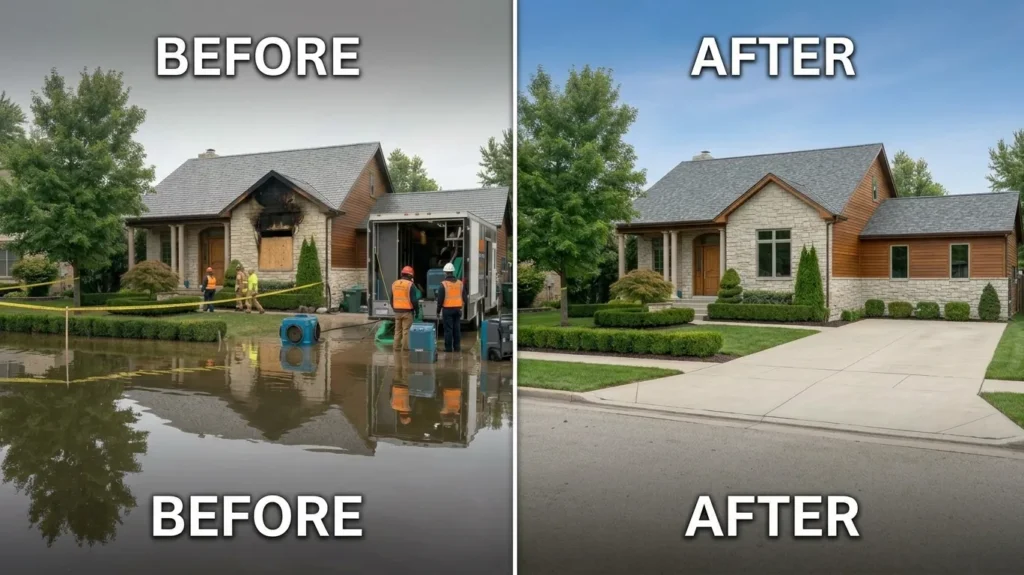
If you are dealing with damage right now, call Air Drop Water Restoration at +1 (678)-374-9247. We will help you move from chaos to a clear plan.
What Are Flood and Flame Restoration Services? A Clear Definition
Flood and Flame Restoration Services are professional mitigation and repair services that remove water, smoke, soot, and contamination from a damaged property, dry and clean the structure, prevent mold, and rebuild it to pre-loss condition.
The services typically include:
- Emergency response and assessment
- Board-up and tarping
- Water extraction and flood cleanup
- Structural drying and dehumidification
- Fire, smoke, and soot cleanup
- Odor removal and air purification
- Contents cleaning and pack-out
- Mold prevention and remediation
- Reconstruction and repair
Flood restoration focuses on water. Flame restoration, also called fire damage restoration, focuses on soot, smoke, char, and the water used to extinguish the fire.
In real life, the two overlap. That is why many homeowners prefer a single team that handles both.
Read other helpful resources: Water Damage Restoration Services and Fire Damage Restoration .
Why Flood and Flame Restoration Services Go Hand in Hand
Fire and water are opposites. But their damage patterns are connected.
Fire Creates Water Damage
Fire hoses can discharge large volumes of water. Sprinkler systems release water throughout the structure. That water soaks drywall, insulation, flooring, and ceilings, often on floors far from the fire.
Flood Creates Fire Risk
Floodwater can damage wiring, panels, appliances, and gas lines. Shorts and sparks may cause fires. Generators, space heaters, and candles used during outages add risk.
Both Create Mold Risk
Wet materials grow mold. Soot and char can mask moisture. Without proper drying, hidden mold takes hold.
Both Need Speed
Both losses worsen over time. Soot becomes acidic. Water wicks upward. Odors set into porous materials. Every hour counts.
Quick Comparison Table
| Factor | Flood Damage | Fire Damage |
| Primary hazard | Water, contamination, mold | Soot, smoke, odor, char |
| Secondary hazard | Electrical failure | Water from firefighting |
| Time sensitivity | Mold begins within 24 to 48 hours | Soot corrodes and stains within hours |
| Key tools | Extractors, air movers, dehumidifiers | HEPA vacuums, dry sponges, air scrubbers, fogging |
| Contamination risk | Category 2 and 3 water | Smoke residue, ash, chemicals |
Flood and Flame Restoration Services for Georgia Weather and Fire Risks
Georgia faces both threats. Local conditions matter.
Flood Risks in Stone Mountain and Metro Atlanta
- Heavy thunderstorms and flash flooding
- Remnants of tropical systems that move inland
- Saturated red clay soil with poor drainage
- Creek and stream overflow in low-lying areas
- Overwhelmed storm drains and sewer backups
- Burst pipes, failed water heaters, and appliance leaks
The National Weather Service in Peachtree City issues flood watches and warnings for the region. The Georgia Emergency Management and Homeland Security Agency offers preparedness guidance.
Fire Risks in Georgia Homes
- Cooking fires
- Heating equipment in cooler months
- Electrical faults in older wiring
- Dryer vent lint
- Candles and holiday decorations
- Lightning strikes during storms
- Wildfire smoke drifting from dry regions
The National Fire Protection Association and Ready.gov provide public safety information on home fire prevention.
Housing Considerations
Atlanta area properties include mid-century ranches, split-levels, townhomes, and newer construction. Each reacts differently to water and smoke. Crawl spaces, basements, attics, and HVAC systems often determine how far damage spreads.
Flood and Flame Restoration Services: The First 24 Hours
The first day decides a lot. Here is a clear plan.
If You Have a Flood
- Prioritize safety. Avoid standing water near electricity.
- Turn off power at the main breaker only if it is safe.
- Stop the source if it is a pipe or fixture.
- Document damage with photos and video.
- Call your insurance carrier.
- Call a restoration company for extraction and drying.
- Remove valuables that can be moved safely.
- Avoid contact with floodwater. It may contain bacteria and contaminants.
The CDC provides health and safety guidance for flood cleanup.
If You Have a Fire
- Get everyone out and call 911.
- Do not re-enter until fire officials say it is safe.
- Call your insurance carrier.
- Call a restoration company for board-up, water extraction, and soot cleanup.
- Avoid touching soot-covered surfaces. Oils on hands can set stains.
- Do not turn on HVAC until it is inspected.
- Do not eat or use food or medications exposed to heat or smoke.
- Keep records of losses and expenses.
Experiencing Flood, fire, or both? Do not try to sort out the damage alone. Air Drop Water Restoration provides emergency flood and fire restoration across Stone Mountain and Metro Atlanta. Call +1 (678)-374-9247 for immediate help.
Flood and Flame Restoration Services: How Flood Restoration Works
Flood restoration is a precise, technical process. Here is how it works.
Step 1: Emergency Assessment
The crew inspects the structure, identifies hazards, and determines the water category and class.
Step 2: Water Extraction
Pumps, extractors, and wet vacuums remove standing water. Fast extraction limits absorption into building materials.
Step 3: Contents Handling
Furniture and personal items are moved, blocked, cleaned, or removed.
Step 4: Moisture Mapping
Meters and thermal cameras identify wet walls, floors, and cavities.
Step 5: Controlled Demolition
Materials that cannot be dried are removed. This commonly includes saturated drywall, insulation, carpet pad, and sometimes flooring.
Step 6: Structural Drying
Air movers circulate air. Dehumidifiers remove moisture. Equipment runs for days with daily readings.
Step 7: Cleaning and Sanitizing
Antimicrobial treatments and HEPA filtration help reduce microbial contamination.
Step 8: Reconstruction
Once dry, drywall, insulation, flooring, paint, and trim are repaired or replaced.
Water Categories in Flood Restoration
| Category | Description | Typical Flood Source |
| Category 1 | Clean water | Supply line break |
| Category 2 | Gray water | Appliance discharge |
| Category 3 | Black water | Storm floodwater, sewage backup |
Floodwater is generally Category 3 because it picks up soil, chemicals, and microbes. Porous materials that contact it, such as carpet, pad, and drywall, usually need removal.
The industry standard is the ANSI/IICRC S500 from the IICRC.
Flood and Flame Restoration Services: How Fire and Smoke Restoration Works
Fire restoration is just as detailed. It is part chemistry, part craftsmanship.
Step 1: Emergency Response and Safety
The crew evaluates structural safety and secures the property. Board-up and roof tarping prevent further loss.
Step 2: Water Removal and Drying
If water was used to fight the fire, extraction and drying begin right away.
Step 3: Soot and Smoke Assessment
Technicians test surfaces to identify the type of soot and residue. This determines the cleaning method.
Step 4: Debris and Char Removal
Burned materials are removed and disposed of properly.
Step 5: Cleaning
Cleaning methods include:
- HEPA vacuuming
- Dry sponge cleaning
- Wet cleaning with specialized solutions
- Abrasive or media cleaning on certain surfaces
- Ultrasonic cleaning of contents
Step 6: Odor Removal
Odor removal may use air scrubbers, thermal fogging, hydroxyl generators, or sealing primers. The approach depends on the materials and the extent of smoke penetration.
Step 7: Contents Restoration
Clothing, furniture, electronics, documents, and keepsakes may be cleaned off-site or restored in a controlled environment.
Step 8: Reconstruction
Framing, drywall, flooring, cabinetry, and finishes are rebuilt.
Types of Smoke and Residue
| Residue Type | Source | Cleaning Approach |
| Dry smoke | Fast, hot fires | Dry cleaning methods first |
| Wet smoke | Slow, low-heat fires | Specialized wet cleaning |
| Protein residue | Cooking fires | Targeted cleaners and odor treatment |
| Fuel oil soot | Furnace puff-backs | Degreasing and extensive cleaning |
Read other helpful resources: Smoke Cleaning and Odor Removal .
Flood and Flame Restoration Services and Mold Prevention
Mold is the shared enemy.
After a flood, materials stay wet. After a fire, firefighting water soaks the structure. In both cases, mold needs only moisture and time.
Why Mold Appears So Quickly
- Wet drywall and wood provide food
- Warm, humid Georgia air accelerates growth
- Hidden cavities dry slowly
- Soot and debris mask damp areas
According to the EPA, drying wet materials within 24 to 48 hours is key to preventing mold.
How Restorers Prevent Mold
- Remove standing water quickly
- Use moisture meters to verify dryness
- Run dehumidifiers and air movers
- Apply antimicrobial treatments
- Remove materials that cannot be dried
- Monitor humidity and moisture daily
When Mold Remediation Is Needed
If mold is already visible or odors persist, professional mold remediation may be necessary. That includes containment, HEPA filtration, removal of contaminated materials, cleaning, and verification.
Read other helpful resources: 24/7 Mold Remediation Service .
Flood and Flame Restoration Services: What Can Be Saved and What Cannot
Owners often want to know what will survive.
| Item Type | After Flood | After Fire |
| Hardwood flooring | Often salvageable if dried quickly with specialty drying | May be refinished if char is limited |
| Carpet and pad | Pad usually replaced; carpet depends on category | Often cleaned or replaced depending on smoke exposure |
| Drywall | Usually removed if saturated or contaminated | Cleaned or replaced depending on smoke and char |
| Upholstered furniture | Often discarded with Category 3 water | Often restorable with professional cleaning |
| Electronics | Usually discarded after submersion | Evaluated; corrosive soot can damage circuits |
| Documents and photos | May be dried or freeze-dried in some cases | Evaluated by specialists |
| Clothing | Often washable if Category 1 or 2 | Often restorable with specialty cleaning |
Every situation is unique. A professional assessment is the only reliable way to know.
Flood and Flame Restoration Services and Insurance Claims in Georgia
Insurance is a major part of recovery. Understanding coverage helps you plan.
Fire Coverage
Standard homeowners policies typically cover fire and smoke damage, including damage caused by firefighting efforts.
Flood Coverage
Standard homeowners policies typically exclude flood. Flood insurance generally comes from the National Flood Insurance Program or a private insurer. The NFIP generally has a 30-day waiting period for new policies. Learn more at FloodSmart.gov.
Water Damage That Is Not Flood
Sudden and accidental plumbing failures are commonly covered. Gradual leaks and neglect are often not.
Smart Claim Steps
- Notify your carrier immediately.
- Document the damage with photos and video.
- Make temporary repairs to prevent more loss and keep receipts.
- Keep damaged items until the adjuster approves disposal.
- Ask your restoration company for moisture logs, estimates, and a scope of work.
- Keep a running list of expenses, including temporary housing.
Air Drop Water Restoration supports clients through the insurance claim process with clear documentation. For consumer guidance, visit the Georgia Office of Insurance and Safety Fire Commissioner.
Flood and Flame Restoration Services for Homes and Businesses
Both residential and commercial properties need rapid response.
Residential Restoration
- Single-family homes
- Townhomes and condos
- Rental properties
- Multi-family buildings
Commercial Restoration
- Retail stores and restaurants
- Offices and medical practices
- Churches and community buildings
- Warehouses and light industrial spaces
Why Business Owners Need Speed
Every day of downtime costs revenue. Fast mitigation, clear communication, and efficient project management reduce interruption.
Need a restoration team that can handle it all? Air Drop Water Restoration handles water, fire, smoke, and mold. One call. One coordinated plan. Call +1 (678)-374-9247 to get started.
How to Choose Flood and Flame Restoration Services in Atlanta
Not every company is built the same. Use this checklist.
Look For
- 24/7 emergency response
- Certified technicians and adherence to industry standards
- Professional equipment such as extractors, air movers, dehumidifiers, HEPA air scrubbers, and moisture meters
- Experience with both flood and fire losses
- Clear communication and written scopes
- Insurance claim support
- Local roots in Stone Mountain and Metro Atlanta
- References and reviews
Questions To Ask
- Are you available right now?
- Do you follow IICRC standards?
- How will you document moisture and drying progress?
- Can you handle both water and fire damage?
- Do you provide contents cleaning and pack-out?
- Will you work directly with my insurance adjuster?
- What is your plan for odor and mold prevention?
Red Flags
- Door-to-door solicitation after a storm or fire
- Pressure to sign immediately
- Refusal to explain the scope
- Cash-only demands or large up-front payments
- No documentation or drying logs
The Air Drop Water Restoration Approach
Air Drop Water Restoration provides water damage restoration, fire damage repair, mold remediation, and emergency plumbing services. We emphasize direct communication and thorough work, so you know what is happening at each step.
Flood and Flame Restoration Services Checklist: What to Do and What to Avoid
Do
- Prioritize safety
- Document everything
- Call your insurance carrier
- Call a restoration company quickly
- Protect undamaged areas
- Keep receipts
- Ask questions
Do Not
- Enter unsafe structures
- Turn on electronics that were wet or exposed to soot
- Use household vacuums on water or soot
- Wipe soot with water
- Use HVAC before inspection
- Throw away items before documentation
- Hire the first contractor who knocks on your door
Expert Tips on Flood and Flame Restoration Services
- Speed is a strategy. The first 24 hours save thousands.
- Take photos from every angle. Time-stamped evidence supports claims.
- Do not trust smell alone. Odors fade, but residues remain.
- Ask about drying goals. Moisture content targets prove readiness.
- Protect indoor air quality. Air scrubbers and HEPA filtration matter.
- Plan for temporary housing. Check your policy for additional living expense coverage.
- Keep a project binder. Include estimates, contracts, logs, and receipts.
- Prevent the next loss. Install smoke alarms, leak sensors, and surge protection.
Flood and Flame Restoration Services Prevention Tips for Atlanta Homeowners
Flood and Water Prevention
- Clean gutters and extend downspouts
- Maintain sump pumps and consider battery backups
- Inspect plumbing and appliance hoses
- Install water leak sensors
- Know where your main water shutoff is
- Review flood insurance options
Fire Prevention
- Test smoke and carbon monoxide alarms monthly
- Keep a fire extinguisher in the kitchen
- Clean dryer vents and chimneys
- Service heating equipment annually
- Never leave cooking or candles unattended
- Keep space heaters away from flammable items
- Create and practice a family escape plan
Preparedness
- Keep important documents in a fireproof, waterproof container
- Photograph or video your belongings for inventory
- Save your restoration company’s phone number: +1 (678)-374-9247
Be ready before disaster strikes.
Save our number and call the moment you need help. Air Drop Water Restoration: +1 (678)-374-9247. Emergency flood and flame restoration for Stone Mountain and Metro Atlanta.
Flood and Flame Restoration Services Areas We Serve in Metro Atlanta
Air Drop Water Restoration provides emergency restoration throughout:
- Stone Mountain, Tucker, Lithonia, Conyers, and Covington
- Atlanta, Decatur, Brookhaven, Dunwoody, and Sandy Springs
- East Point, College Park, Union City, and Mableton
- Marietta, Smyrna, Kennesaw, Roswell, Alpharetta, and Johns Creek
- Lawrenceville, Duluth, and Suwanee
- Stockbridge, McDonough, Peachtree City, Fayetteville, Douglasville, and Newnan
For city resources, visit the City of Atlanta website. For environmental guidance, see the Georgia Environmental Protection Division.
Flood and Flame Restoration Services Timeline: What to Expect Day by Day
Owners often ask how long the process takes. Every loss is different, but this timeline gives you a realistic picture.
| Phase | Typical Timeframe | What Happens |
| Emergency response | Hours | Safety check, board-up, tarping, water extraction |
| Assessment and documentation | Day 1 | Moisture mapping, soot testing, photos, scope of work |
| Demolition and debris removal | Days 1 to 3 | Removal of unsalvageable materials |
| Drying and dehumidification | Days 2 to 7 | Air movers and dehumidifiers with daily readings |
| Cleaning and odor control | Days 3 to 10 | HEPA cleaning, soot removal, deodorization |
| Contents restoration | Days 3 to 14 | Cleaning, pack-out, and storage of belongings |
| Reconstruction | Weeks | Drywall, flooring, cabinetry, paint, and finishes |
Why Timelines Vary
- Size of the loss: A single room is different from a whole floor.
- Water category: Category 3 water requires more removal.
- Material type: Hardwood, plaster, and concrete dry slowly.
- Weather and humidity: Georgia humidity can slow drying.
- Insurance approvals: Scope approval can affect scheduling.
- Supply availability: Specialty materials may take time to arrive.
How Daily Monitoring Works
During drying, technicians return to take moisture readings, adjust equipment, and record progress. Those logs prove the structure reached its drying goals. They also support your insurance documentation.
Hidden Dangers After Flood and Fire Damage
The visible damage is only part of the story. Several hazards stay hidden until a professional inspection.
Electrical Hazards
Water and heat both damage wiring, outlets, and panels. Damaged electrical systems can shock people or start new fires. Never turn on power to a wet or fire-damaged area until a qualified professional has inspected it.
Structural Concerns
Fire weakens framing, trusses, and floor systems. Floodwater can soften subflooring and compromise sheathing. If a floor feels spongy or a ceiling sags, stay out and call a professional.
Indoor Air Quality
Smoke leaves fine particulate matter and chemical residues. Floods can leave bacteria and mold spores. Both reduce air quality. HEPA air scrubbers and proper cleaning help restore it.
Contaminated Materials
Floodwater and sewage can contaminate drywall, insulation, carpet, and upholstery. Fire can leave ash and chemical residue on everything it touches.
Gas and HVAC Systems
Flooded furnaces and water heaters need inspection before use. After a fire, ductwork may carry soot throughout the home. Running the system can spread contamination.
Quick Hazard Checklist
- Do not enter if the structure appears unstable
- Do not touch electrical equipment in wet areas
- Do not run HVAC until inspected
- Do not use food or medicine exposed to smoke, heat, or floodwater
- Wear protective gear if you must handle contaminated items
- Call a professional before cleanup
Unsure whether your property is safe? Air Drop Water Restoration can assess your property and explain the safest next steps. Call +1 (678)-374-9247 and get a professional opinion today.
Flood and Flame Restoration Services: What Affects the Cost?
No two losses cost the same. Here are the main factors.
Flood Restoration Cost Drivers
- Water category and class
- Square footage affected
- Depth and duration of standing water
- Materials involved
- Equipment and drying days
- Demolition, disposal, and reconstruction scope
Fire Restoration Cost Drivers
- Size and severity of the fire
- Smoke and soot type
- Amount of structural damage
- Odor penetration
- Contents cleaning and pack-out
- Reconstruction scope
Ways To Reduce Total Cost
- Call early. Fast mitigation shrinks the scope of reconstruction.
- Document everything. Clear evidence supports claim approval.
- Ask for a written scope. You should know what is included.
- Protect undamaged areas. Close doors and avoid spreading soot or water.
- Work with one coordinated team. Fewer handoffs mean fewer delays.
Frequently Asked Questions About Flood and Flame Restoration Services
What are Flood and Flame Restoration Services?
Flood and Flame Restoration Services are professional services that remove water, smoke, soot, and contamination from a property after a flood or fire. They include extraction, drying, cleaning, odor removal, mold prevention, contents restoration, and reconstruction.
Why does a fire often lead to water damage?
Firefighters use large amounts of water, and sprinkler systems also discharge water. That water soaks building materials and must be extracted and dried to prevent mold and structural damage.
How soon should I call a restoration company after a flood or fire?
As soon as it is safe. Mold can start within 24 to 48 hours, and soot can stain and corrode surfaces within hours. Early response reduces damage and cost.
Is floodwater dangerous?
Yes. Floodwater is typically Category 3 and may contain bacteria, sewage, and chemicals. Avoid contact and do not attempt cleanup without proper protection. Professional restoration is strongly recommended.
Can smoke damage be removed completely?
Often yes, with proper cleaning and odor treatment. The result depends on the smoke type, the materials, and how quickly cleaning begins. Some porous items may need replacement.
Does homeowners insurance cover flood and fire damage?
Fire and smoke are commonly covered. Flood typically requires a separate flood insurance policy. Sudden plumbing leaks are often covered. Review your policy and speak with your agent.
How long do flood and flame restoration services take?
Small jobs can finish in days. Larger losses take weeks or months, especially when reconstruction is needed. Drying alone usually takes several days.
Can I stay in my home during restoration?
It depends. Heavy smoke, Category 3 water, mold, or structural damage may make the home unsafe. Your restoration team will advise you after inspection.
Do you work with insurance companies?
Air Drop Water Restoration supports clients through the claims process with detailed documentation and clear scopes of work.
Do you serve commercial properties?
Yes. We assist homeowners, landlords, and business owners across Metro Atlanta. Call +1 (678)-374-9247 to discuss your property.
Conclusion: Flood and Flame Restoration Services You Can Trust
Flood and Flame Restoration Services are about more than cleanup. They are about safety, speed, science, and peace of mind.
Remember these essentials:
- Prioritize safety first.
- Document the damage.
- Call your insurance carrier.
- Call a restoration professional immediately.
- Dry the structure to prevent mold.
- Choose a team that handles both flood and fire.
Air Drop Water Restoration delivers water damage restoration, fire and smoke cleanup, mold remediation, and emergency plumbing support for Stone Mountain and Metro Atlanta.
Flood or fire? Call now, Call Air Drop Water Restoration at +1 (678)-374-9247. We respond, restore, and rebuild. Learn more at airdropatlanta.com.