 Skip to content
That musty, earthy smell in your Atlanta home isn’t just unpleasant, it’s often the first and only warning sign of a hidden mold problem growing behind walls, under flooring, or inside HVAC systems. This guide walks through exactly what to do if you smell mold in your house: how to identify the odor, where mold typically hides in Atlanta Georgia homes, why you can smell mold before you can see it, when a musty smell signals a health concern, and the step-by-step process a certified mold inspector follows to find the source. You’ll also learn which situations call for DIY air-freshening versus a professional mold inspection, and how Atlanta’s humidity accelerates mold growth compared to drier climates.
Table of Contents
If you smell mold in your house but can’t see it anywhere, you’re dealing with one of the most common, and most frustrating, indoor air quality problems Atlanta homeowners face. That musty, earthy, sometimes sour odor is caused by microbial volatile organic compounds (MVOCs), gases released as mold colonies grow and metabolize, and it’s frequently detectable well before any visible staining or discoloration appears on a surface.
Call Air Drop Water Restoration When You Smell Mold in Your House in Atlanta
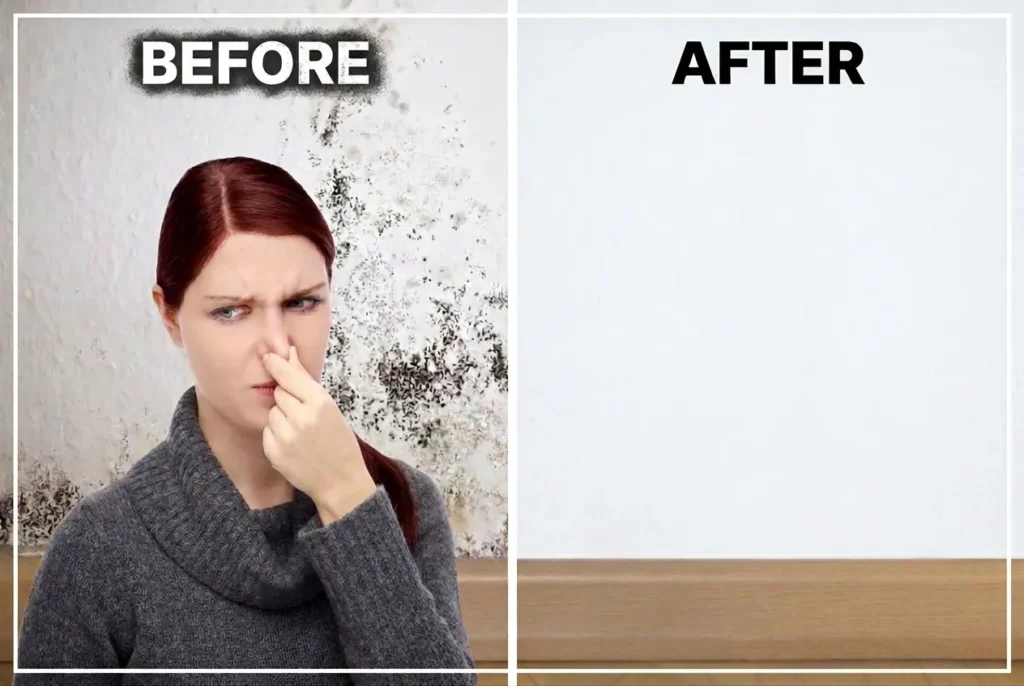
Atlanta’s humid subtropical climate is part of the problem. Between heavy summer thunderstorms, high ambient humidity, and homes with crawlspaces, basements, and HVAC systems that cycle warm moist air, conditions across metro Atlanta neighborhoods, from Decatur bungalows to Alpharetta new-builds, are consistently favorable for mold growth once moisture is present.
This guide walks through what that smell actually means, where mold most commonly hides in Georgia homes, the health considerations to be aware of, and the exact steps to take, from initial investigation through professional mold inspection and remediation, so you can address the problem at its source instead of just masking the odor.
Smell something musty but can’t find the source? Air Drop Water Restoration offers certified mold inspection across metro Atlanta to find exactly what’s causing the odor.
Why You Can Smell Mold Before You Can See It
Mold produces a distinct musty odor because of MVOCs released during active growth, and these compounds can travel through HVAC ductwork, wall cavities, and flooring assemblies far beyond the actual colony. This is why a homeowner will often smell mold strongly in a hallway or bedroom while the actual growth is happening inside a wall cavity, under a bathroom vanity, or above a drop ceiling several feet away.
A visible mold colony typically needs 24 to 48 hours of sustained moisture exposure to begin forming on an organic surface like drywall paper or wood, and this is precisely why untreated moisture can lead to measurable mold colonization within just one to two days, according to restoration industry standards. The smell, however, can become noticeable even earlier, making it a genuinely useful early-warning signal if you take it seriously.
A musty smell in your house almost always means active mold growth somewhere in the structure, even if nothing is visible. The correct first step is to investigate likely hiding spots yourself, then call a certified mold inspector if you can’t locate and safely address the source within a day or two.
Common Places Mold Hides in Atlanta Homes
Before scheduling a professional inspection, it’s worth checking the locations where Atlanta homes most commonly develop hidden mold, especially in properties with crawlspaces, older HVAC systems, or basement-level living space.
- Behind and underneath bathroom vanities, around wax rings and supply line connections
- Inside HVAC ductwork and around the evaporator coil, particularly in humid Georgia summers
- Crawlspaces with inadequate vapor barriers, common in older East Atlanta and Decatur homes
- Behind drywall near exterior walls where insulation has trapped condensation
- Under carpet padding following an unaddressed spill or slow leak
- Inside kitchen cabinetry beneath sinks and around dishwasher connections
- Basements and finished lower levels with a history of minor flooding or seepage
- Around window frames and sills where condensation regularly collects
- Attic spaces with roof leaks or poor ventilation
Step-by-Step: What to Do If You Smell Mold in Your House
- Trust the smell, even without visible staining, a persistent musty odor is a reliable indicator of active mold somewhere in the structure
- Narrow down the location by walking room to room; the odor is typically strongest closest to the source
- Check the common hiding spots listed above, bathrooms, under sinks, HVAC vents, crawlspace access, basement corners
- Look for a related moisture source, a past leak, condensation, high humidity, or poor ventilation
- Avoid disturbing any visible mold growth yourself; scrubbing or spraying it can release spores into the air and spread contamination
- If you find the source and it covers less than roughly 10 square feet, minor surface mold on a hard, non-porous surface can sometimes be addressed with proper protective equipment; anything larger, on porous material, or of unknown origin warrants a professional
- If you can’t locate the source within a day or two, or the smell is strong and persistent, schedule a certified mold inspection
- Improve ventilation and reduce humidity in the meantime, run exhaust fans, a dehumidifier, or open windows when Atlanta’s outdoor humidity is lower
When a Mold Smell Is a Health Concern
Mold exposure affects people differently. According to the Environmental Protection Agency, mold can trigger allergic reactions, respiratory irritation, and worsened asthma symptoms in sensitive individuals, particularly children, older adults, and people with existing respiratory conditions. If anyone in your household is experiencing unexplained coughing, sinus congestion, headaches, or worsening allergy symptoms that improve when they leave the house, that’s a meaningful signal to prioritize inspection rather than waiting.
You do not need to identify the mold species to justify remediation. The EPA’s guidance is that if visible mold or a mold odor is present, it should be addressed regardless of type, since testing for species is rarely necessary to determine that remediation is needed.
If anyone in your household is experiencing unexplained respiratory symptoms, don’t wait. Schedule a mold inspection with Air Drop Water Restoration today.
Mold Growth Conditions: Comparison Table
| Condition | Low Mold Risk | High Mold Risk (Common in Atlanta) |
| Indoor humidity | Below 50% | Above 60%, common in Georgia summers without dehumidification |
| Ventilation | Consistent air exchange, functioning exhaust fans | Poor crawlspace/attic ventilation, sealed bathrooms without fans |
| Moisture history | No prior leaks or flooding | Past leak, slab moisture, or storm-related water intrusion |
| Building age/type | Newer construction with modern vapor barriers | Older homes with original crawlspace or basement moisture issues |
DIY Odor Investigation vs. Calling a Certified Mold Inspector
Homeowners can reasonably investigate visible, accessible areas themselves. However, several situations call for a certified mold inspector rather than continued DIY investigation:
- The smell is strong but you cannot locate any visible source after checking common hiding spots
- The odor is concentrated near a crawlspace, basement, or HVAC system you can’t easily access
- You’ve had a past water damage event, even a minor one, in the area where the smell is strongest
- Household members are experiencing respiratory symptoms that improve away from home
- You’re buying or selling a home and need documented mold testing for a real estate transaction
- You suspect mold inside HVAC ductwork, which requires specialized inspection tools
What a Professional Mold Inspection Involves
Visual and Odor-Guided Assessment
A certified inspector begins with a thorough visual walkthrough, using the odor itself as a guide, combined with moisture meters and, when needed, a borescope to examine wall cavities without unnecessary demolition.
Moisture Mapping
Thermal imaging and moisture meters identify hidden dampness behind walls, under flooring, and in crawlspaces, revealing the underlying condition that’s allowing mold to grow, not just the mold itself.
Air Quality and Surface Sampling
When appropriate, air samples and surface swabs are collected and sent to an accredited laboratory to identify mold type and spore concentration, providing documentation for remediation planning or real estate disclosures.
Written Report and Remediation Plan
You receive a detailed report outlining findings, the underlying moisture source, and a scope of work for remediation, which also supports any related insurance claim.
Expert Tips: Preventing Mold Odor From Returning
- Run a dehumidifier in basements and crawlspaces to keep humidity below roughly 50%
- Ensure bathroom and kitchen exhaust fans vent outside, not into the attic
- Address any leak, no matter how minor, within 24-48 hours to prevent colonization
- Install or repair crawlspace vapor barriers, especially in older Atlanta and Decatur homes
- Have HVAC systems and ductwork inspected annually, particularly before Georgia’s humid summer season
- Keep gutters clear and grade soil away from the foundation to reduce basement moisture intrusion.
Get a documented mold inspection report you can use for remediation planning, peace of mind, or a real estate transaction. Contact Air Drop Water Restoration to schedule yours.
Frequently Asked Questions On What to Do If You Smell Mold in Your House
What to Do If You Smell Mold in Your House?
Mold typically produces a musty, earthy odor, sometimes described as smelling like wet socks, old books, or damp soil. The intensity often increases in humid conditions or when HVAC systems are running.
Call Air Drop Water Restoration When You Smell Mold in Your House in Atlanta
Can you smell mold but not see it?
Yes, this is extremely common. Mold releases microbial volatile organic compounds that travel through walls, flooring, and ductwork, so the smell can be noticeable in rooms well away from the actual growth.
Call Air Drop Water Restoration When You Smell Mold in Your House in Atlanta
Is it dangerous to sleep in a room that smells like mold?
Prolonged exposure to mold odor and spores can cause respiratory irritation, allergic symptoms, and worsened asthma in sensitive individuals. If a room consistently smells musty, it’s best to identify and address the source rather than continuing to use the space as normal.
Call Air Drop Water Restoration When You Smell Mold in Your House in Atlanta
How do I get rid of a musty smell in my house permanently?
Air fresheners and odor sprays only mask the smell temporarily. Permanently resolving a musty odor requires locating the mold source, removing the moisture that’s feeding it, and properly remediating any affected materials.
Call Air Drop Water Restoration When You Smell Mold in Your House in Atlanta
Should I test for mold or just assume it’s there if I smell it?
The EPA notes that if mold odor or visible mold is present, remediation is generally needed regardless of species, so testing isn’t always required to justify taking action. Testing becomes more valuable when you need documentation, for a real estate transaction or insurance claim, or when the source can’t be visually located.
Call Air Drop Water Restoration When You Smell Mold in Your House in Atlanta
Can mold smell come from HVAC ducts?
Yes. Condensation around the evaporator coil and moisture inside ductwork can support mold growth that circulates a musty odor throughout the entire house whenever the system runs.
Call Air Drop Water Restoration When You Smell Mold in Your House in Atlanta
How much does a certified mold inspection cost in Atlanta?
Cost varies based on home size and whether air or surface sampling is included. A certified inspector can provide an exact quote after understanding the scope of your concern; contact Air Drop Water Restoration for a straightforward estimate.
Call Air Drop Water Restoration When You Smell Mold in Your House in Atlanta
What’s the difference between mold inspection and mold remediation?
Mold inspection identifies the presence, extent, and source of mold growth. Mold remediation is the actual removal and cleanup process, including addressing the underlying moisture problem so the mold doesn’t return.
Call Air Drop Water Restoration When You Smell Mold in Your House in Atlanta
Conclusion
A musty odor in your house is never something to ignore, especially in Atlanta’s humid climate, where hidden moisture can turn into a full mold colony within a matter of days. The right response is methodical: investigate common hiding spots, avoid disturbing visible growth, address any obvious moisture source, and bring in a certified mold inspector when you can’t locate the problem yourself or when the smell persists.
Air Drop Water Restoration has helped Atlanta homeowners track down and resolve hidden mold problems for over a decade, using moisture mapping, thermal imaging, and accredited lab testing to find the real source, not just mask the smell. If you’re smelling mold in your house right now, contact Air Drop Water Restoration for a certified mold inspection across metro Atlanta.
A musty smell in your Atlanta home is your first warning sign, not something to mask and ignore. Air Drop Water Restoration provides certified mold inspection and remediation across Fulton, DeKalb, Cobb, and Gwinnett counties. Contact us today to find the source and protect your home and your health.